


No Fades, No Dye, No Loose Hair at Mopan Tech
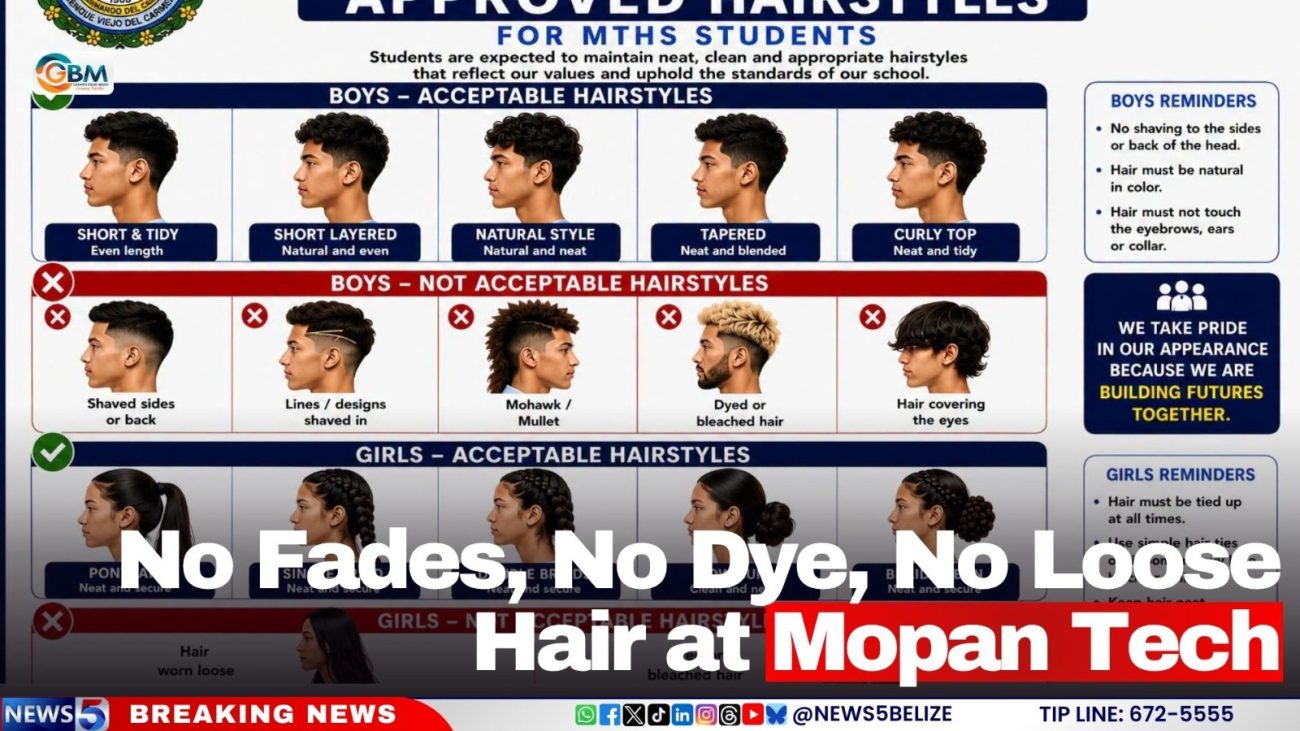
Five days ago, Mopan Technical High School in Benque Viejo del Carmen posted an “Approved Hairstyles” guide to its Facebook page, a graphic featuring what appears to be AI-generated images of students modelling acceptable and unacceptable haircuts and hairstyles, alongside a list of grooming rules for boys and girls.
The post, paired with a longer reminder to parents ahead of the school’s August 24th reopening, has since reignited a debate that has followed Belizean secondary schools for over a year.
The graphic lays out specific do’s and don’ts. For boys, acceptable styles include short and tidy cuts, tapered fades, and natural curly tops, with rules stating hair must be natural in colour, must not touch the eyebrows, ears, or collar, and must not be shaved at the sides or back. Mohawks, mullets, dyed or bleached hair, and shaved-in designs are listed as unacceptable. For girls, approved styles include ponytails, braids, and buns, worn neat and secure, with hair required to be tied up at all times using simple navy blue, black, or white ties or ribbons. Loose hair and dyed or bleached hair are marked as not acceptable.
In the accompanying message to parents, the school framed the policy as being about more than appearance. “Some may ask, ‘What does hair have to do with learning?’ The answer is more than we sometimes realise. School is not only about academic knowledge. We are preparing young people for their future, for the workplace, further education, leadership, and life. Learning to follow reasonable standards of appearance, demonstrate self-discipline, respect rules, and present oneself appropriately are all part of becoming responsible and successful adults.”
Principal Katie Jones echoed that reasoning directly, standing by the school’s grooming standards as a matter of discipline rather than personal expression. She told News Five, “While some people say that hair has nothing to do with learning, we do believe that it sets discipline and standards for our school,” adding that the boundaries help prepare students for professional environments where strict uniform and grooming expectations are the norm. “It is our fault if we don’t really have these things that are going to guide them throughout their life.”
The renewed attention comes against the backdrop of a national conversation that first flared up last August, following incidents at schools including Anglican Cathedral College. At the time, the Belize National Teachers’ Union issued a statement opposing what it characterised as discriminatory hair policies, aligning itself with the UBAD Educational Foundation. “The BNTU stands in solidarity with UBAD Educational Foundation against discriminatory hair policies in schools. We are deeply concerned by reports of students being reprimanded, suspended, or otherwise penalised for wearing hairstyles that reflect their heritage or religious beliefs.”
News Five spoke to the Chief Education Officer, Yolanda Gongora, who told us that the ministry is looking into the matter and is not yet able to offer an official comment.
Meanwhile, the school’s reminder triggered a wave of reactions online, showing a noticeable divide among parents and the community.
Some praised the initiative, calling it vital preparation for employment. One commenter says it’s a “great initiative”, adding, “When they go into the real world, it’s not if you want or like… you have to for the rules of your job or no job at all.” Another supporter agreed, commenting, “I concur; it’s called discipline and self-care.”
Others questioned the relevance of the restrictions. One commenter urged schools to “move away from this colonialist mindset”, while another wrote, “Imagine thinking keratin length dictates IQ. Focus on the curriculum, not the barber shop.” Concerns were also raised regarding cultural representation, with one parent noting that the approved options felt “too limited” and asking, “What about the females of Creole descent? Braids and cornrows have become very popular among schoolgirls.”