


Belize River Fish Kill: What Happened, What Caused It and What Comes Next
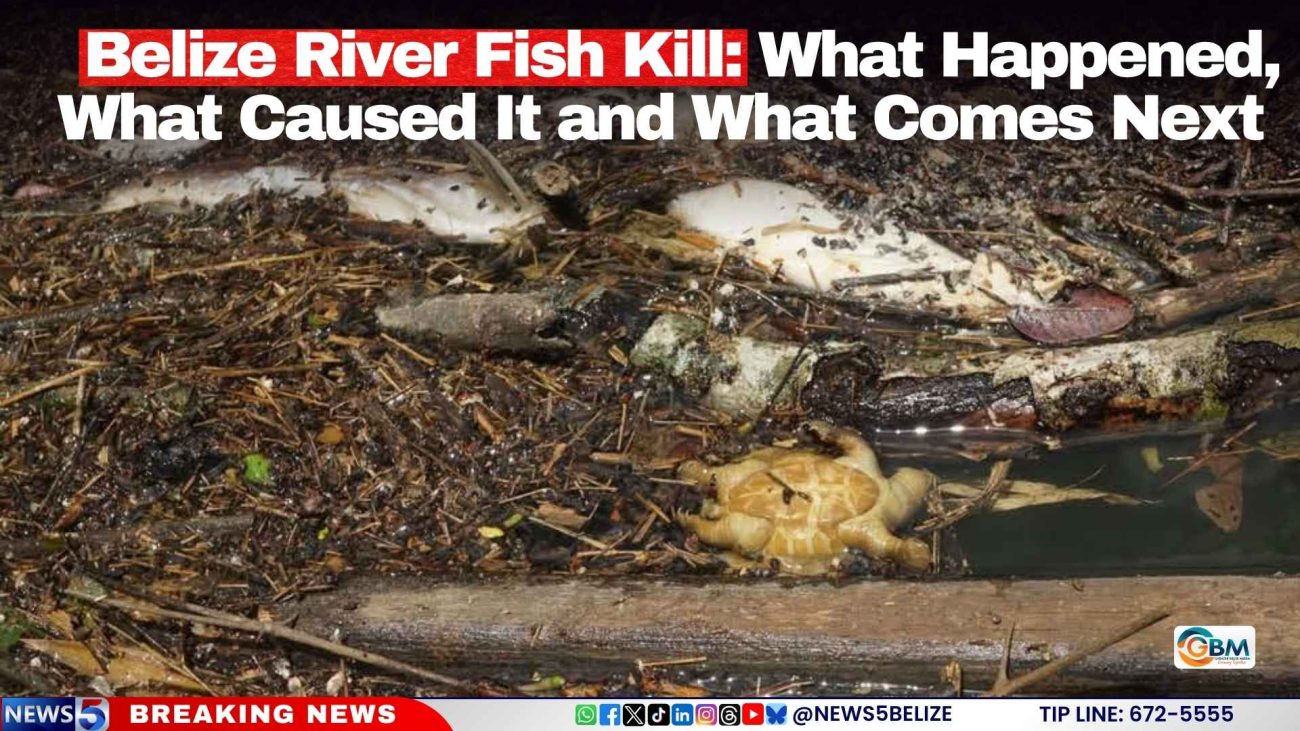
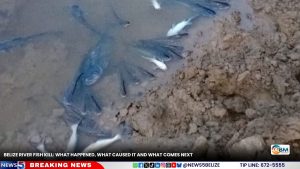
The good news is that the 17.5 mile stretch of the Belize River is now back to a “normal state,” according to the Department of the Environment (DOE). While it may have recovered from last month’s major fish kill, questions remain as to what led to it and what comes next.
The DOE broke down its findings Friday night at a Public Information Session in Double Head Cabbage. Chief Environmental Officer Anthony Mai presented the findings of the department’s environmental monitoring and outlined a series of corrective measures.
The investigation examined everything from possible diseases and agricultural activity to chemical contamination, algae growth, water quality and postmortem examinations of dead fish.
So what actually happened to the Belize River?
Belize River Fish Kill: What Happened, What Caused It and What Comes Next
What Killed the Fish, and Where
Was this disease? No.
The DOE ruled out possible disease as “highly unlikely.” Chief Environmental Officer Anthony Mai explained that “In a river environment, whenever there is a disease, it normally affects one species. In this case, there were multiple species of fish, and we received reports that there were even a crocodile and turtle that died.”
According to the DOE’s timeline, satellite imagery showed the Belize River in a normal condition on May 22. By July 23, however, discoloration was visible coming from the direction of Labouring Creek, coinciding with the period when water receded from a rice field.
On August 2, another area of discoloration was visible coming from Santander’s discharge outlet. The following day, August 3, the DOE began receiving reports of a fish kill.
Satellite imagery and water-quality results identified Isabella Bank as the most affected area, although affected sections were also recorded around Flowers Bank and Scotland Halfmoon.
Aerial images initially showed three large, dark patches in the river that resembled a spill of “crude oil.” However, on the ground inspection revealed these patches were entirely mats of algae.
Belize River Fish Kill: What Happened, What Caused It and What Comes Next
How Fertilizer Turned into a Fish Kill
Here is the mechanism, in Mai’s own words: “Nutrients is what plants need for it to grow. Farmers normally add fertilizer for plants to grow fast… but when those same fertilizers wash up into the rivers, they also allow algae to grow fast, because algae is a plant.”
That process is called eutrophication, nutrient overload that sends algae growth into overdrive. And once algae takes over “it blocks the sunlight from coming in, and everything at the bottom of the water begins to die,” Mai said.
The more algae grows, the more oxygen it starts to consume. “Once the oxygen levels get low enough, you have fish kill,” he added.
Necropsies backed this up. Postmortem of fish collected at the affected sites showed excessive mucus, blood from the anus, redness across the fins, body and gill cover, and clouded eyes, all consistent with one cause: hypoxia, oxygen starvation.
The department also examined the possibility that agrochemicals were responsible. Water samples detected traces of agrochemicals as far downstream as Flowers Bank.
However, DOE’s conclusion points back to “a high organic load entering the river over a short period of time, which triggered mild eutrophication. The eutrophication decreased the dissolved oxygen level, which led to the fish kill.”
Belize River Fish Kill: What Happened, What Caused It and What Comes Next
Is The River Safe Now, and What Happens Next?
Can you swim in it? The DOE says yes. Can you eat the fish? Not yet
The DOE addressed several questions from community members, including those coming in during the livestream session.
In a response comment, the DOE said, “The Department is of the opinion that the river is safe for recreational activities; however, is cautious to conclusively state that the fish can be safely consumed considering that additional assessment is being carried out to definitively arrive at a conclusion.”
Mai says the river has returned to a “normal state.” To keep it that way, the DOE has identified ten corrective actions:
- The first is to meet with approximately 24 farmers operating along or near the affected sections of the Belize River and establish targets, including restoring the legally required 66-foot reserve along the waterway, which is the buffer of public land required along Belize’s waterways.
- Restore the riparian forest.
- Improve water management, soil and nutrient management, and climate-smart measures on farms near the Belize River.
- Establish an early system to detect changes in the river early. Mai admits the department’s current technology is limited, but hopes these tools can be expanded to use for future monitoring and issuing timely warnings.
- Develop a long-term monitoring plan for the Belize River.
- Continue analyzing the data already collected, share with relevant agencies, and develop or strengthen policies and legislation.
- Identify one lead government agency for watershed management.
- Reconvene the Belize River Watershed Committee.
- Update the Belize River Watershed Management Plan (BRWMP).
- Ensure that each agency plays its part in implementing the requirements of the BRWMP.
Belize River Fish Kill: What Happened, What Caused It and What Comes Next
Mai said the incident should serve as a warning to everyone who depends on the Belize River, saying, “This fish kill event is an eye-opener for me, as the chief environmental officer, and I hope that it is an eye opener for everyone, because Belize River is critical; it’s a very essential water body for this country. Collectively, we cannot allow this river to degrade.”
“The only way we could ensure that the river is protected is if we all play our part,” Mai said.