

Who Says You Need a Boat Trip to Experience Turneffe? Put on a VR Headset
A child in a Belizean classroom may know about Belize’s coral reefs. They may have heard of the colourful fish swimming through them, seen photos of the country’s clear blue waters, maybe even learned Belize is home to one of the world’s most important marine ecosystems.
But they’ve likely never seen it for themselves.
Taking an entire class to Turneffe takes planning that most schools don’t have time for, permission slips, money, coordinating boats, and so much more. For some children, that trip simply never happens.
And it is not only children who miss out. There is always that one friend, family member or colleague who stays on the boat because they cannot swim, do not dive or simply do not feel comfortable going into the water.
Now, none of that has to keep them from experiencing Turneffe, because the atoll is coming to them in all its glory.
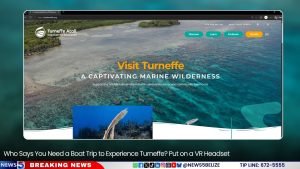
The Turneffe Atoll Sustainability Association (TASA) is using virtual reality to bring Belize’s largest marine protected area straight into classrooms and communities without requiring anyone to step on a boat, or even get into the water.
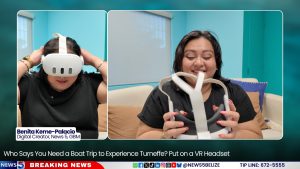
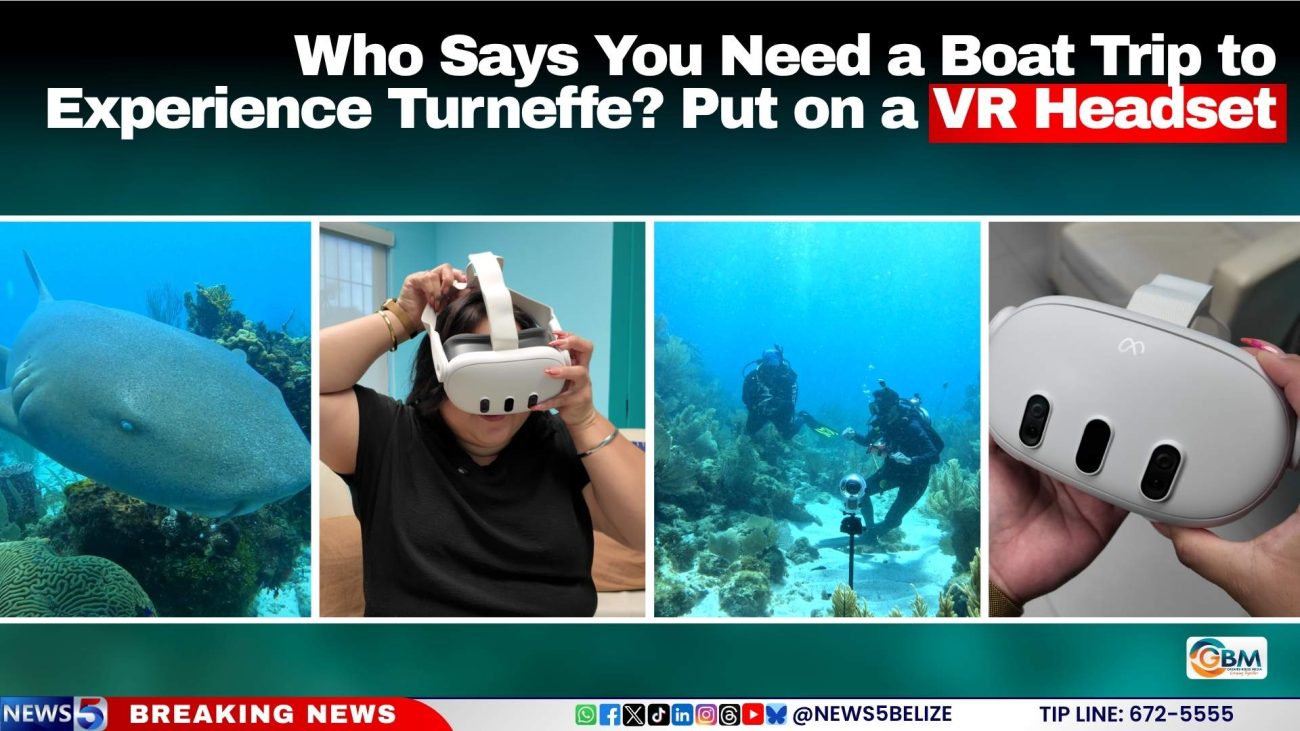
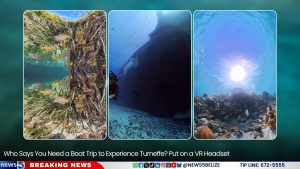
Two new VR headsets allow users to explore Turneffe through 360-degree footage of Belize’s very own mangroves, seagrass beds, coral reefs, and much more.
“Turneffe is a great treasure of the world and of Belize,” said TASA’s Executive Director, Valdemar Andrade. “Many people don’t even understand that the Turneffe marine reserve is an hour, an hour and a half offshore. And so we are trying to let people through these technologies get there, understand what is there, understand what belongs to them and then how can they be involved in its management or at least enjoy the ecosystem.”
It puts Belize’s underwater world within reach of anyone willing to step into the VR experience.
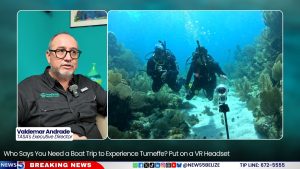
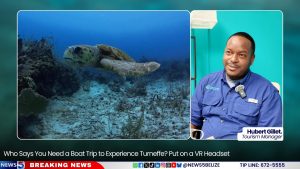
“These are not AI generated footage. These are actual footage from Turneffe at the Marine Reserve. And this is what makes it special. This is our heritage,” said Tourism Manager Hubert Gillet.
The first film glides through five interconnected ecosystems, mangroves, seagrass beds, reef flats, coral reef and Turneffe’s dramatic drop-off wall, all in under four minutes.
A second film takes viewers to the Wit Wreck, where marine life has turned a sunken vessel into an artificial reef.
“You can put on a VR headset and say, that’s the place that I want to dive,” Gillet added. He said underwater videographer Duarte Dellarole spent a week at Turneffe capturing the footage specifically for the project.
For TASA, however, the headsets are an education tool, one that could put Turneffe in front of thousands of Belizean students who may just become the ones to manage the reserve in the future.
“The ultimate goal for that is to stimulate students to be able to say, ‘hey, you know what, I want to be a conservation officer, or I want to be a marine biologist, or I want to engage with tourism at that level, or divemaster, or tour guide,’” said Gillet.
Behind the two headsets sits a much bigger technology push.
Over the past three years, TASA has built out radar systems at Mauger Caye and Caye Bokel, thermal drones, and a data platform called SMART, all working to protect the reserve while cutting costs.
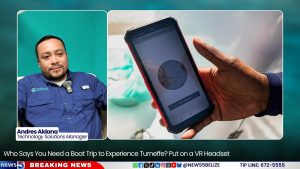
Technology Solutions Manager Andres Aldana says patrols once meant sending a boat out regardless of whether anything was happening. Now, radar geofences trigger alerts the moment a vessel lingers in a protected zone, and drones respond first.
“Turneffe is quite large and Turneffe has many areas that we can’t all reach at the same time,” Aldana said. “So we would deploy the drone. Now if during that drone deployment there is vessel activity, then the patrol continues and goes to that specific target. It has reduced the fuel consumption in terms of patrol deployments; it’s been effective and efficient for our patrol teams out on the ground.”
Every piece of technology TASA adopts carries a financial payoff alongside the ecological one. Patrols once burned through roughly $150,000 in fuel a year. Andrade’s long-term goal is cutting that figure in half. “We’re nowhere close there yet,” he admitted, “but over time, we’re hoping to get to the point where we can reduce that cost.
The VR project cost roughly $10,000 for both headsets and the footage, fully funded by the Protected Areas Conservation Trust. For TASA, that investment means an entire ecosystem can now be brought into a classroom in Belize City, Punta Gorda or anywhere else without a single boat trip.
TASA has already tested how far that reach can go. Itz’at STEAM Academy owns its own VR sets, so TASA is partnering with the Academy by sharing the footage. “These are some of the amazing partnerships that we hopefully want to develop, especially with our core partners,” Gillet said.
And while one part of TASA’s technology is bringing Turneffe closer to Belizeans through the two VR headsets, another part is helping protect it.
That work, however, depends on continued support.
Aldana says the appetite to expand this technology is there, but it depends on funding beyond what TASA has managed to secure. “It’s very important that we get other funders who want to build this technology,” he said.
“With the evolving technology, there is constantly a need for support from donors, from locals, from even from visitors, from international,” Gillet added.
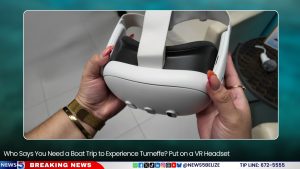
Whether it’s an in-person tour of the atoll or putting on the VR headset, Andrade is inviting everyone “to experience Belize’s natural wealth.”
“We are in the National Month of Celebration. And this is a part of the heritage and a part of the culture and a part of the natural wealth that you own,” Andrade added.