



A National Legacy Rooted in Mahogany
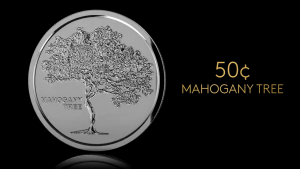
Long before tourism and agriculture powered Belize’s economy, mahogany was king. Known as “red gold,” the towering tree built communities, fueled the timber trade and helped shape British Honduras. Now, centuries after leaving its mark on the nation, mahogany is being honored on Belize’s latest collectible coin. Tonight, on Kolcha Tuesday, Paul Lopez digs into the complicated and enduring legacy of the tree rooted deeply in Belize’s identity.
Paul Lopez, Reporting
British settlers once came to Belize in pursuit of mahogany, transforming the towering hardwood into the backbone of the colonial economy. Centuries later, Henry Fairweather gave the tree’s story a new chapter. The former land surveyor, affectionately known as the “Mahogany Man,” planted more than one hundred thousand mahogany trees along the Sibun River, helping to preserve a species deeply connected to Belize’s history.
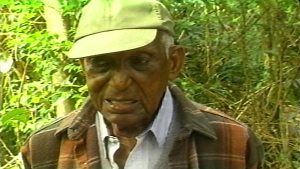
Henry Fairweather
Henry Fairweather, Former Land Surveyor, (File: Feb 9th, 2000)
“I have no textbook to follow on this. It is just my long knowledge of the forest and my desire to do something for the country.”
Fairweather put his money behind his vision, investing hundreds of thousands of dollars to plant mahogany across four hundred acres. He believed the tree once known as “red gold” could still deliver lucrative returns.
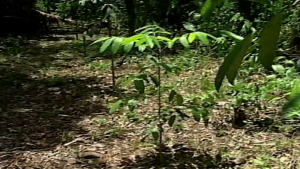 Henry Fairweather
“I want them to plant enough Mahogany for them to sell. And it must be sustainable. That they would be able to grow it continuously and live by that and stop giving other people, particularly those funding people trouble or headache in helping them along. The business of Mahogany is not play business, it is strictly hard work, a lot of sacrifices, a lot of punishment in doing without the things you need.”
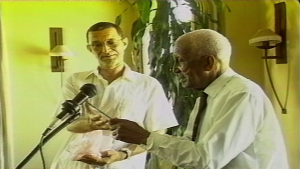 Fairweather later received the James A. Waight Conservation Award for his approach to sustainable conservation. But Fairweather’s vision came at a steep cost. When News Five interviewed him in 2000, his mahogany business was already struggling financially. And because the trees take about twenty years to mature, he never lived to see the profitable operation he had imagined. Today, mahogany may not be the money-making business it once was, but its value has been immortalized on the latest series of collectable coins released by the Central Bank of Belize.
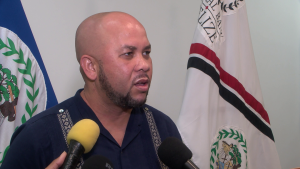
Delroy Rhaburn
Delroy Rhaburn, Assistant Manager, Currency Management
“We explored using the Mahogany Tree or the Toucan. Unfortunately, because coins are so small there are some color restrictions as to how many colors you can use. The toucan is about eight colors and two difficult to represent accurately on the coin. So, we decided to do the mahogany tree. It was already on the largest coin. So that is why we went with the Mahogany tree.”
Delroy Rhaburn reflects on the historical significance of the tree to Belize.
 Delroy Rhaburn
“The tree is our national tree. We know that it played a big role in Belize’s history. Everybody knows the mahogany tree and the toucan when you think about our national symbols. So we feel like that was an appropriate subject for the painted coin.”
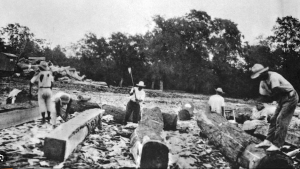 Mahogany’s legacy remains firmly etched into Belize’s national identity. The tree stands prominently on the Coat of Arms, alongside two woodcutters and the tools that powered the country’s early economy. More than a national symbol, it represents an industry that helped shape Belize’s development, culture and history.
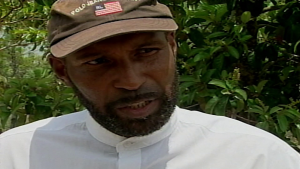
Adalbert Tucker
Adalbert Tucker , Former Coordinator, Belize River Valley Development Program, (File: April 12th, 2000)
“Mr. Fairweather, by working in harmony with nature, was able for example, not to cut down the land, but to plant back in the land what has been taken out and to show that it would give you the peace and harmony that we truly need as a nation.”
From the forests that built a colony to a coin that celebrates a nation, the mahogany tree remains one of Belize’s most enduring symbols of heritage, resilience, and identity. Reporting for News Five, I am Paul Lopez.
Attention readers: This online newscast is a direct transcript of our evening television broadcast. When speakers use Kriol, we have carefully rendered their words using a standard spelling system.