


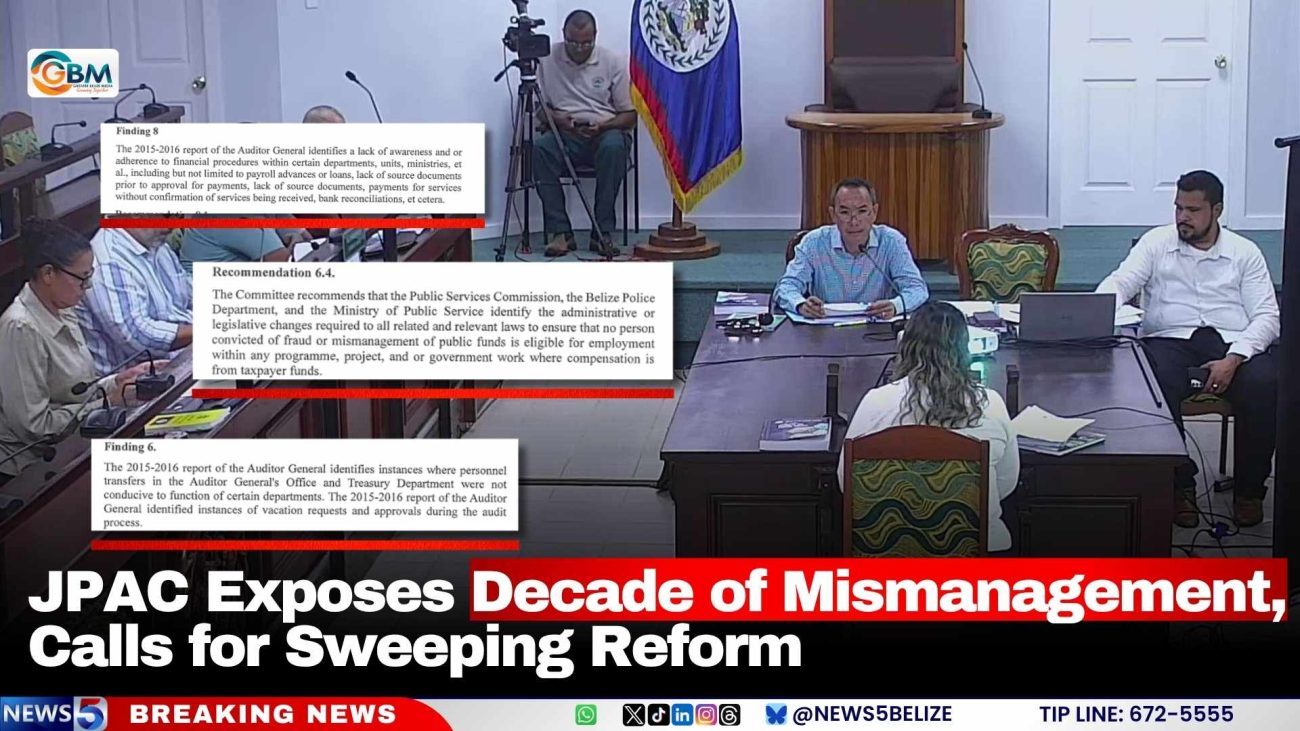
JPAC Exposes Decade of Mismanagement, Calls for Sweeping Reform
A parliamentary committee charged with guarding Belize’s public finances has released a damning report painting a picture of systemic dysfunction across government…one where ministries ignore auditors, financial rules date back to the 1960s, public records go missing, and the country’s chief auditor lacks the independence to do her job properly.
The Joint Public Accounts Committee (JPAC), chaired by UDP Area Representative Lee Mark Chang of Mesopotamia, tabled its report in November 2025 after reviewing the Auditor General’s Report for the financial year April 2015 to March 2016, a document that was itself nearly a decade overdue when it was referred to the committee.
Only One Ministry Responded to the Auditor General
Perhaps the most striking finding in the entire report is this: of every ministry, department, and government unit in Belize, only one, the Ministry of Health, responded when the Auditor General reached out with her findings and recommendations for the 2015–2016 audit year.
Every other government institution went silent.
Under Part 8(42) of the Finance and Audit (Reform) Act, relevant personnel are legally required to communicate with and respond to the Auditor General. The report found that the mass non-response created what is known in auditing as a “scope of limitation”, meaning the Auditor General could not obtain sufficient evidence to do her work, because the people managing public money simply refused to engage. The committee is recommending that all current financial officers, chief executive officers, and ministers be required to provide written responses confirming whether the 2015–2016 recommendations were ever acted upon. It has also called on the Ministry of Finance to create or strengthen regulations that legally compel government entities to respond when the Auditor General comes calling.
The Auditor General Had to Issue a Disclaimer — Because Key Documents Don’t Exist
The 2015–2016 Auditor General’s report carries a formal disclaimer of opinion, the most serious qualification an auditor can issue. It means the Auditor General could not form any conclusion about the accuracy of the government’s financial statements, because the supporting source documents were either unavailable or simply missing.
The committee found that the problem extends beyond 2015–2016. Multiple annual audit reports remain unproduced because the Accountant General never submitted those statements to the Auditor General as required under Section 15(1) of the Finance and Audit Reform Act.
No statements submitted means no audit can be conducted. No audit means no accountability.
JPAC has called on the Financial Secretary to urgently convene a meeting with the Accountant General to determine the full scope of the problem, specifically, to confirm whether source documents for any year actually exist, and to identify how many additional fiscal years will carry the same disclaimer. Critically, the committee also recommended that where the existing report provides legal grounds to surcharge or discipline public officers, those responsible offices must act and keep the Financial Secretary informed throughout.
The Auditor General Has No Real Independence
The committee found that the Office of the Auditor General operates without meaningful independence.
The Auditor General currently cannot publish audit reports independently, cannot issue reports directly to the public, and has no separate budget. This means that the very institution responsible for auditing the government depends on that same government for its funding and operations.
Auditor General Maria Rodriguez, who appeared under oath at the committee’s October 24 public hearing, disclosed that a U.S. Government Accountability Office review conducted in January 2025 specifically recommended that her office gain the authority to independently publish reports, achieve budgetary independence through a direct submission to the National Assembly, and obtain control over its own human resource management.
The committee is recommending that the Financial Secretary provide a formal position statement on granting the Auditor General independent publishing authority, direct public reporting capability, and a standalone budget. If there is support for reform, the Ministry of Finance must then seek legal guidance on the legislative changes required.
Financial Rules Haven’t Been Updated Since the 1960s

RF&G Insurance: ‘It Pays to Get it Right!”
During its November 17 meeting, committee member Senator Kevin Herrera raised an issue that left members visibly frustrated: the Financial Orders (the day-to-day rulebook that tells public officers how to handle government money) have not been updated since the 1960s.
The Finance and Audit (Reform) Act was passed in 2011. Yet the Financial Orders that public servants are expected to follow were written more than half a century ago and have never been revised to align with the newer legislation. Senator Herrera noted this creates genuine legal confusion: public officers do not know which set of rules applies, and that uncertainty is being used, whether intentionally or not, as cover for non-compliance.
This directly connects to another finding: the 2015–2016 report documented staff responsible for financial compliance expressing “unfamiliarity” with the Financial Orders. The committee found it difficult to distinguish between genuine ignorance and willful avoidance and recommended that the Financial Secretary conduct an analysis to determine whether the language and meaning of the financial orders themselves require reform to provide clarity.
As a priority action, JPAC voted to hire an independent consultant to review the Financial and Store Orders and update them in line with current legislation.
Government Records Were Improperly Handled — or Are Gone
The report found that government records, files, and documents across multiple entities were not properly handled, maintained, or disposed of in accordance with the law, which requires their preservation for 20 years.
Physical records from past years were described at the public hearing as being in poor condition and scattered across multiple storage locations. In some cases, records appear to have been destroyed without the legally required notification to the JPAC.
The committee recommended a national review to ensure adequate storage exists across all government ministries and departments, a formal circular reminding all personnel of their legal obligations around records management, and a specific circular to financial officers reminding them that JPAC must be notified before any government records are destroyed.
Staff Transfers and Vacations Were Approved During Active Audits
The report revealed a pattern that undermined the audit process itself: key staff in the Auditor General’s Office and the Treasury Department were transferred away or approved for vacation leave while audits were actively underway.
The result was that the people auditors needed to speak with were unavailable at critical moments, whether by coincidence or design, the committee did not say. What it did say is that the Auditor General and Accountant General currently have almost no control over their own staffing decisions, which are managed by the Ministry of Public Service.
Accountant General Teresita Miranda confirmed at the public hearing that her department experiences 30% annual staff attrition, with 90% of those departures resulting from transfers approved by the Ministry of Public Service.
The committee is recommending that a formal meeting be held between the Ministry of Finance, Ministry of Public Service, Auditor General, and Accountant General to explore ways to give both audit offices meaningful input over hiring, retention, compensation, and leave decisions for their staff.
It also recommended that anyone convicted of fraud or mismanagement of public funds be permanently barred from any government-compensated work, a legislative change that would require the Public Services Commission, the Belize Police Department, and the Ministry of Public Service to act jointly.
Belize Could Be Waiting Until 2029 for Current Audits
The sheer scale of the reporting backlog is staggering. The committee is currently reviewing an audit report covering 2015–2016. The Auditor General testified that, without the authority to audit multiple fiscal years simultaneously, and assuming the Accountant General submits financial statements without delay going forward, the earliest her office could be fully current is 2029.
The Accountant General confirmed that financial statements for fiscal years 2019–2020 have been submitted, but source documents from line ministries remain limited, raising the likelihood of further disclaimer opinions. Under the current legal framework, if statements continue being submitted one year at a time, the financial data for the current fiscal year of 2025–2026 will not even be ready for submission until January 2028.
She added that restructuring the department to properly separate the duties of those preparing financial statements from those verifying them would cost less than $100,000 per year through the addition of two to three staff positions.
The Same Problems Were Flagged in 2018, and Nothing Changed
Annexed to the JPAC’s current report is the 2018 Minority Report, covering the 2012–2013 audit year. It was included deliberately, the committee said, to highlight the similarities between the two reports, in other words, to make visible what a decade of inaction looks like.
The 2018 report warned that financial mismanagement had been increasing every year, regardless of which political party was in power. It estimated that Belize was losing tens of millions of dollars annually to incompetence, corruption, dishonesty, or omission. The Ministry of Works alone lost $1,188,873.90 during the 2012–2013 period due to non-compliance with store orders.
The 2018 report estimated that implementing all of its recommendations would cost less than $2 million per year and called on the PAC and the House to act immediately.
Seven years later, the same institutions are before a new committee, with the same findings.
What Happens Next
The UNDP has offered a forensic accountant consultant to support the committee’s analytical work on pending reports, which also include unreviewed audits for 2014–2015 and two special reports on the Sports Council and Julian Cho Technical High School.
The JPAC is also pursuing a dedicated budget from the Ministry of Finance, including provisions for legal support, research assistance, and media coverage of public hearings, recognising that without resources of its own, the committee cannot fully exercise the oversight mandate it is constitutionally given.
In his foreword, Chang wrote that accountability in public finances is a shared national responsibility. The report’s eleven findings and more than twenty recommendations now go to the full House for adoption.
Whether this time is different remains to be seen.