


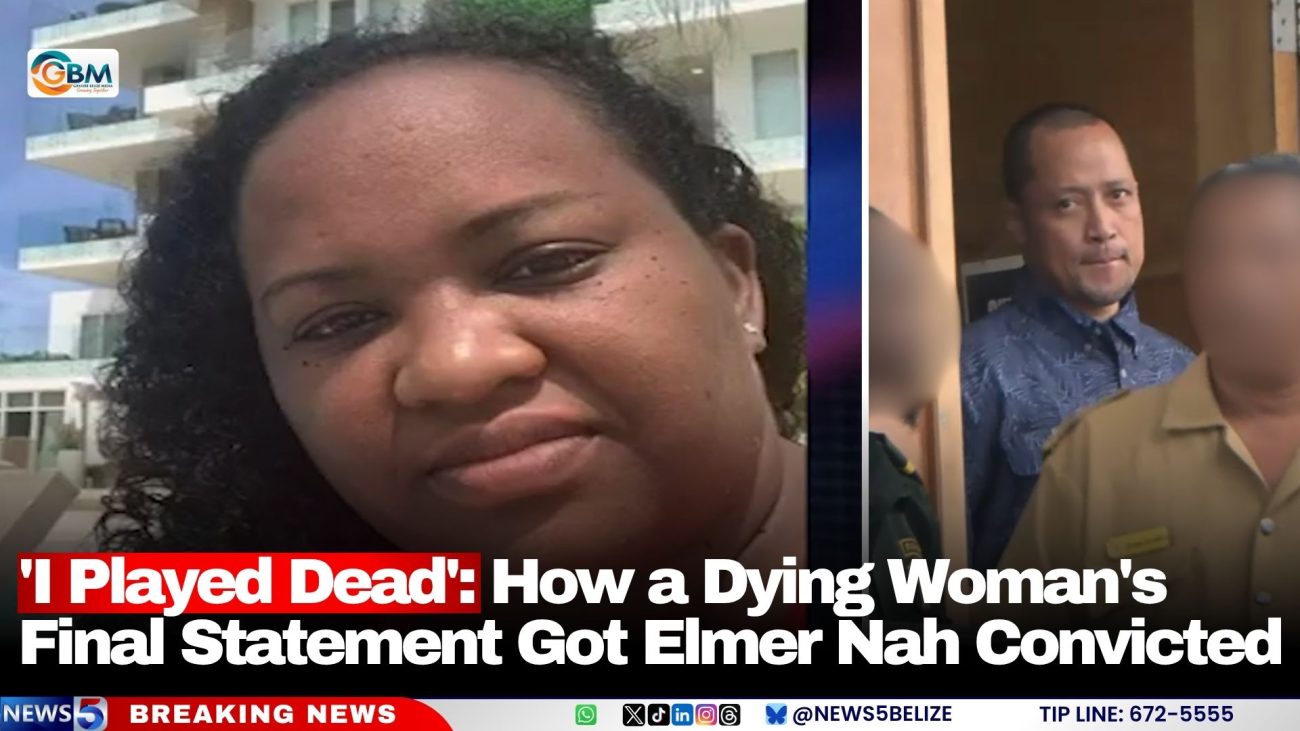
‘I Played Dead’: How a Dying Woman’s Final Statement Got Elmer Nah Convicted
Elmer Nah, once a serving officer of the Belize Police Department, was convicted last week of three counts of murder and one count of attempted murder.
Nah was found guilty of murdering Jon Ramnarace, David Ramnarace, and Vivian Ramnarace and the attempted murder of Yenie Alberto in Belmopan on the last night of 2022.
Jon’s wife Vivian survived the initial attack but died on 15 January 2023 from complications arising from her gunshot wounds. A fourth victim, Yenie Alberto, David’s common-law partner, was shot in the abdomen but survived after fleeing through the back of the house.
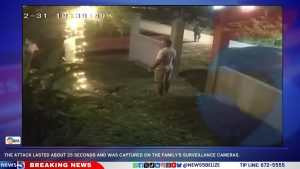
According to witness testimony and surveillance footage, Jon and Vivian Ramnarace were at home with family on the evening of the attack when their dog began barking shortly after 7:30 p.m. Jon and David Ramnarace stepped outside to investigate, followed by Vivian and Yenie Alberto. A gunman dressed in dark clothing approached and opened fire, fatally shooting Jon, David, and Vivian, while also wounding Alberto as she fled. The attack lasted about 25 seconds and was captured on the family’s surveillance cameras.
“Vivian stated that she was ‘seriously afraid’ and remembered that was sitting up on the floor when the gunman stood about 1 foot away from her and shot
Page 14 of 60 at her once that caught her in the face. Vivian leaned over and “played dead”.
The most pivotal evidence in the case came from Vivian herself. Despite suffering four gunshot wounds, she recovered her mobile phone, called a neighbour, contacted her family on WhatsApp, and called emergency services before police arrived. She survived long enough to give a formal statement to police on 2 January 2023, less than 48 hours after the attack, while recovering at Karl Heusner Memorial Hospital in Belize City.
‘I Played Dead’: How a Dying Woman’s Final Statement Got Elmer Nah Convicted
In that statement, admitted before the court as hearsay evidence, Vivian described the gunman in detail. She estimated she saw him for a combined total of 8 to 10 seconds: outside the house in lamppost and Christmas-light illumination from a distance of about 15 feet, and again inside the house under kitchen lights at a distance of approximately 8 feet. She said the gunman wore no mask and she saw his face clearly. She described him as a light-complexioned young man, roughly 5 feet 6 inches tall, in full dark clothing, with an unidentified object on top of his head emitting light.
Vivian told police she had seen the gunman before, not in person, but on television, when he was charged in connection with a plane landing case. She described him as “Vidal’s nephew police,” a reference the court found unmistakably pointed to Elmer Nah, whose uncle, Marco Vidal, was a former senior police superintendent. Nah had himself been charged in a widely-publicised 2021 drug trafficking case involving a plane landing, with photographs of him broadcast extensively across Belizean media and social media.
Later that same afternoon, Vivian participated in a photo array procedure conducted at her hospital bedside. She was shown a folder of 12 photographs of men of similar complexion and appearance. After studying the images for approximately 20 seconds, she raised her hand and, without hesitation, identified photograph number 10, which bore the image of Elmer Nah.
The defence mounted a vigorous challenge to the identification evidence, arguing that it amounted to a mistaken identification by a witness under extreme stress, that Vivian’s use of the phrase “it looked like Number 10” when asked to repeat her selection revealed doubt, and that the failure to conduct a formal identification parade was unjustifiable and fatal to the reliability of the identification. The defence also pointed to the absence of DNA, fingerprints, or gunshot residue linking Nah to the scene, and argued that the tattoo visible on Nah’s hand from wrist to knuckles could not be seen on the shooter’s hand in the video footage.
Justice Nigel Pilgrim rejected each of these arguments. He found Vivian Ramnarace to be an honest and reliable witness whose account was corroborated in remarkable detail by surveillance footage she could not have seen before giving her statement. The court noted nine specific points of convergence between her written account and the video: the behaviour of the dogs, the sequence in which the adults came outside, the “fast walk” approach of the gunman, the order in which the victims were shot, the forcing open of the front door, the light source on the shooter’s head, the lamppost and Christmas lights she described, and the kitchen lighting inside the house.
‘I Played Dead’: How a Dying Woman’s Final Statement Got Elmer Nah Convicted
On the phrase “it looked like Number 10,” Justice Pilgrim invoked the principle that courts cannot ignore the “often very loose habits of speech of Belizeans in the streets of our cities and towns,” finding it was simply a turn of phrase immediately preceded by a firm, unprompted identification seconds earlier. On the tattoo, the court found the video footage too grainy to determine conclusively whether the shooter’s hands were clear or tattooed. On the failure to hold an identification parade, the court accepted the prosecution’s explanation that Vivian was bedridden in intensive care and physically unable to attend one. The court also noted the Privy Council authority that identification parades serve limited purpose where a witness has already provided a complete identification by name or description sufficient to enable police to take a suspect into custody.
Justice Pilgrim identified several strands of circumstantial evidence that he found supported the correctness of Vivian’s identification, though he emphasised that even without them, the hearsay statement supported by the video evidence alone was sufficient to satisfy him of guilt.
When police arrived at Nah’s home on Messam Street later that same night, they found him at the front door of his property wearing a lit headlamp on his head, precisely the kind of light source Vivian had described on the shooter and which appeared in the surveillance footage. The court noted that Nah’s home was at most five to seven minutes’ walk from the Ramnarace residence, and that the shooter in the footage arrived and departed on foot.
Rubber boots seized from the back of Nah’s grey pickup truck were sent to the FBI Laboratory in the United States for forensic analysis. FBI footwear examiner Brian McVicker gave evidence that a boot impression found on the door of the Ramnarace home corresponded in outsole design and physical size with the left boot seized, concluding it “could have made this impression.” The court, however, declined to place weight on this evidence, noting that it could not be sure the boots seized were the same ones worn by the shooter, and that the class-characteristic conclusion fell short of a definitive match.
The court found that Nah told a deliberate lie about his whereabouts in the critical window between 7:00 p.m. and 8:00 p.m. on the night of the killings. In his police interview, conducted less than two days after the shooting, he stated he visited the Wei Li bar beside his home during that period. Surveillance footage from the Wei Li shop, however, showed no sign of him at any point between 5:00 p.m. and 8:30 p.m. By the time of trial, Nah’s account had shifted. He claimed his visit to the bar was after 9:00 p.m., a time irrelevant to the commission of the offences. The court found this was not a mistake but a deliberate fabrication intended to provide an alibi for the hour of the murders.
Nah elected to give a dock statement at trial. He maintained that he had been wrongly identified and that he was at home with family during the time of the killings. He said he had been washing his tennis shoes in the yard when he heard what he thought were firecrackers being let off for New Year’s Eve celebrations, and had not paid it any attention. He said he later went to bring in his sheep on a dirt bike with his cousin.
Alibi evidence was given by his cousin Amin Nah, who testified that the defendant was beside him in the yard at the time of the gunshots, and by his common-law wife Epifania Caliz, who said he was at home around 7:30 p.m. Former colleague Dervin Sambula testified that he called Nah at around 8:30 p.m. that night and that his voice sounded normal. The court rejected all of this evidence. Justice Pilgrim noted that Amin Nah and Caliz were close relatives with a clear moral incentive to provide an alibi, and that the Wei Li lie had gravely damaged Nah’s own credibility. He found that Sambula’s calm-voice evidence, taken even at face value, could be explained by the defendant’s confidence that his crime would not be detected.
Nah also argued that the absence of the tattoo visible on his hand in the shooting video exonerated him. The court found that the footage quality was insufficient to resolve this issue either way.
A separate sentencing hearing will be held on June 18th. Under Belizean law, murder carries a mandatory sentence.