


News 5 Journalists Strengthen Investigative Skills Through International Training Programme
As demands grow for deeper reporting and greater accountability, journalists at Greater Belize Media (News 5 Belize) are sharpening the skills needed to deliver it.
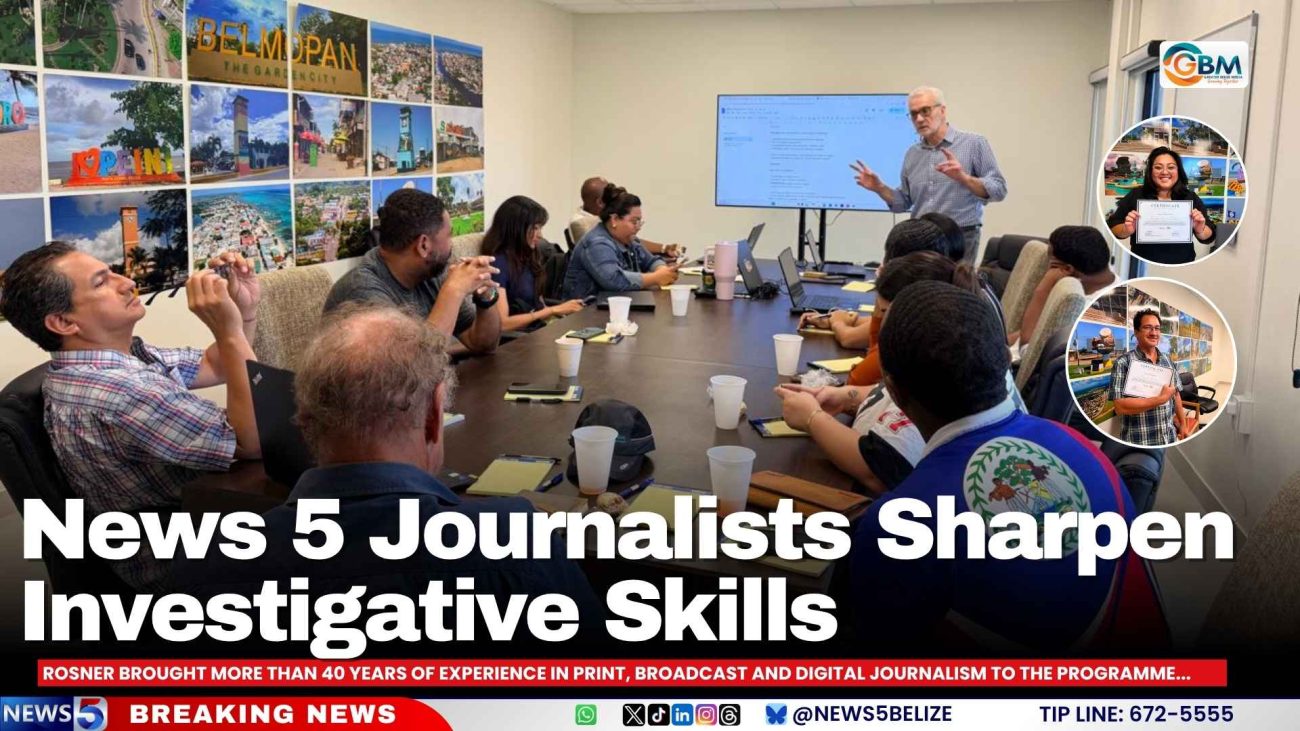
Reporters, editors, digital journalists and newsroom managers recently completed a two-day investigative journalism workshop led by veteran Canadian journalist Cecil Rosner, an award-winning reporter and managing editor of the Investigative Journalism Foundation. The training was funded through the Public Media Alliance’s Trainer Grant programme, part of its Global Grants initiative supported by the Grace Wyndham Goldie (BBC) Trust Fund.
The sessions focused on practical investigative techniques, including open-source intelligence gathering, accessing and analysing public records, ethical use of artificial intelligence, interviewing strategies and storytelling methods. Participants also explored the legal and ethical challenges that often accompany investigative reporting.
News 5 Journalists Strengthen Investigative Skills Through International Training Programme
Rosner said one of the key challenges facing journalists in small media markets like Belize is the constant pressure from powerful actors to shape the news agenda. “Journalists everywhere face pressure to report stories that outside interests want to place on the agenda. This includes governments, corporations, the police and other organisations that are always putting out press releases, holding press conferences or otherwise trying to influence the agenda,” he said. “This is especially problematic in small news markets like Belize, where there are limited resources. It’s important to act independently and carve out enough time to look into topics that really matter to the community, whether the powers-that-be wish them to be examined or not.”
The sessions focused on practical investigative techniques, including open-source intelligence gathering, public records analysis, ethical use of artificial intelligence, interviewing strategies and storytelling methods. Participants also explored the legal and ethical challenges that often accompany investigative reporting.
Rosner said documents and public records remain among the most powerful tools available to journalists. “Documents can be powerful evidence in news stories,” he said. “Whether it is a report, or a record of land ownership, or a lawsuit, these are important and often very accessible documents that can help journalists get closer to the truth.” He added that open-source intelligence, when properly applied, can significantly strengthen reporting when combined with traditional interviewing and verification.
News 5 Journalists Strengthen Investigative Skills Through International Training Programme
On the growing use of artificial intelligence in newsrooms, Rosner said journalists must both embrace and critically scrutinise new tools. “AI is going to have an effect on everything in our world, and journalism is no different,” he said. “AI can be of major assistance in the research phase of a story… At the same time, we are in the early days of AI development. AI platforms can and do make mistakes. Journalists need to be on constant guard to double-check and verify any information that AI produces.”
For Marleni Cuellar, CEO of Great Belize Productions Ltd., the training reflects changing expectations from audiences who want more than just the day’s headlines. “Audiences globally are demanding more of their local newsrooms, not just answers from those in power, but the fuller picture: the context, the consequences, and the impact and relevance of each story on their lives. Belizeans are no different,” Cuellar noted.
The workshop arrived at what News Editor Isani Cayetano described as a pivotal moment for journalism in Belize, where newsrooms are increasingly being asked to produce more in-depth reporting despite limited resources and tighter deadlines. “The programme strengthens our capacity to dig deeper, ask tougher questions, and follow stories beyond the surface, journalistic skills that are essential in holding power to account and serving the public interest,” Cayetano said.
Digital Editor Hipolito Novelo said the workshop reinforces the newsroom’s commitment to producing journalism that goes beyond surface-level reporting. “Strong investigative reporting is built on persistence, verification and context. This training gave our team valuable tools to strengthen those areas while adapting to the realities of modern journalism. Ultimately, it helps us tell more meaningful stories and better serve the Belizean public,” Novelo said.
Rosner, drawing on more than four decades of experience in print, broadcast and digital journalism, said strong investigative reporters tend to share core traits: curiosity, skepticism, rigour, and a commitment to evidence-based reporting. He added that they must be collaborative, open-minded, and willing to revise assumptions when evidence demands it.
He also encouraged Belizean journalists to carve out space for deeper accountability reporting. “For such a small country, Belize has an impressive array of journalists who are willing to tackle bigger projects,” he said. “I think newsrooms need to devote a portion of their time to delving into the ‘why’ of stories rather than just the ‘what’.”