


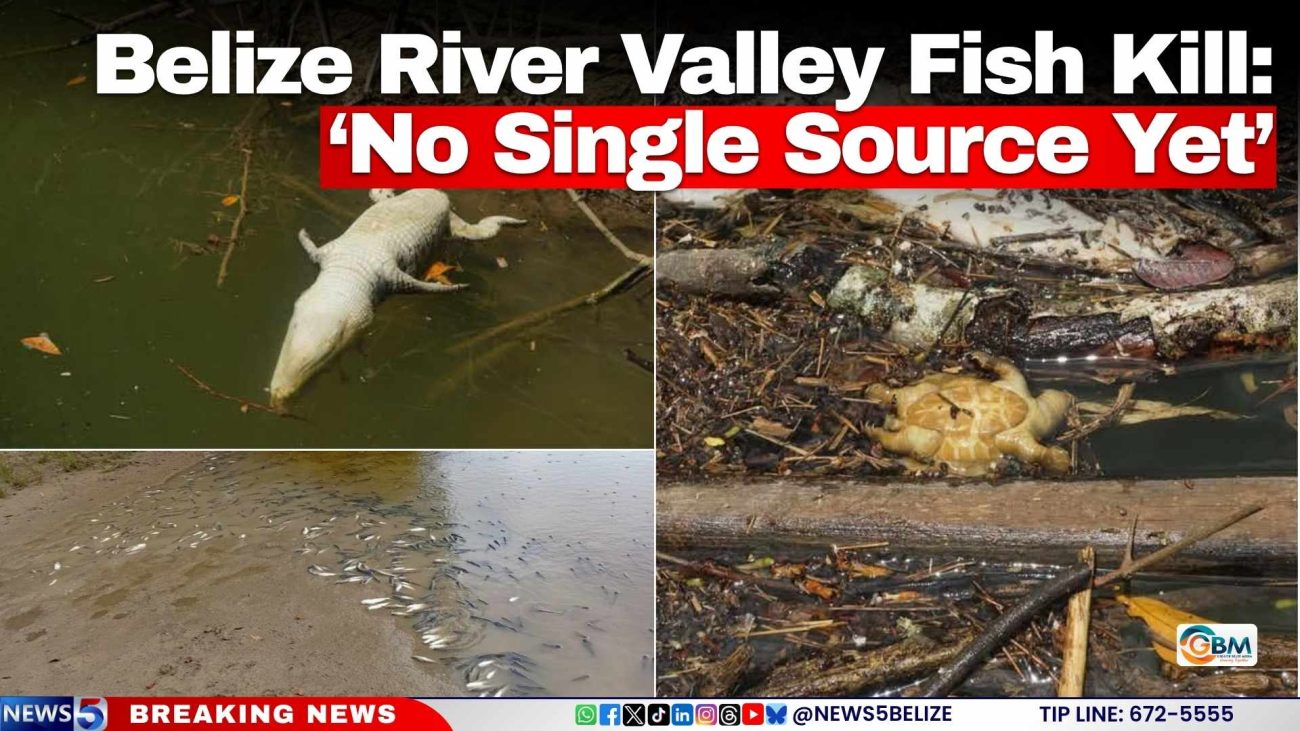
Belize River Valley Fish Kill: ‘No Single Source Yet’
The Department of the Environment’s investigation into last week’s fish kill in the Belize River Valley confirmed on Tuesday that fish died from hypoxia, low dissolved oxygen caused by agricultural runoff and flooding.
Chief Environmental Officer Anthony Mai said a necropsy conducted by Dr Abel Carias ruled out disease, since the kill affected multiple species rather than one. Mai said the same oxygen depletion likely explains why turtles and crocodiles died too, as anoxic conditions produce toxic hydrogen sulphide gas that floats on the water’s surface, where the animals breathe.
Mai said that water quality data showed the lowest oxygen levels and highest fish mortality between St Paul’s Bank and Grace Bank. Elevated chlorophyll-A readings pointed to an algae bloom driven by nutrient runoff.
However, attention quickly focused on Santander Sugar after reports that canals in the area may connect to waterways feeding the Belize River. According to the DOE, there is currently no evidence to pin the fish kill on Santander or any single source.
Meanwhile, satellite imagery showed severe flooding at Santander Sugar’s farm and surrounding agricultural land just before the event, sending large volumes of water into the river.
“That large amount of water from this field went into the river and may have definitely contributed to the change in the aquatic ecosystem, the increased algae, the low dissolved oxygen, et cetera,” May said.
Mai said Santander Sugar has cooperated fully with the investigation and confirmed the company is not the only agricultural operation whose canals feed the affected waterway.
He said the Pesticide Control Board also conducted an inspection on the type of agrochemicals Santander Sugar uses. The findings will be used to compare with the chemical analysis and sediment sampling being conducted locally by Belizean experts.
Most results are expected by the end of this week. Mai stated that the investigation has proven to be a collaborative effort involving 15 different agencies, including the University of Belize, the Belize Agricultural Health Authority, the Fisheries Department, and more.
In the meantime, researchers are monitoring the river, as contaminated water could affect communities further downstream before reaching the sea.