


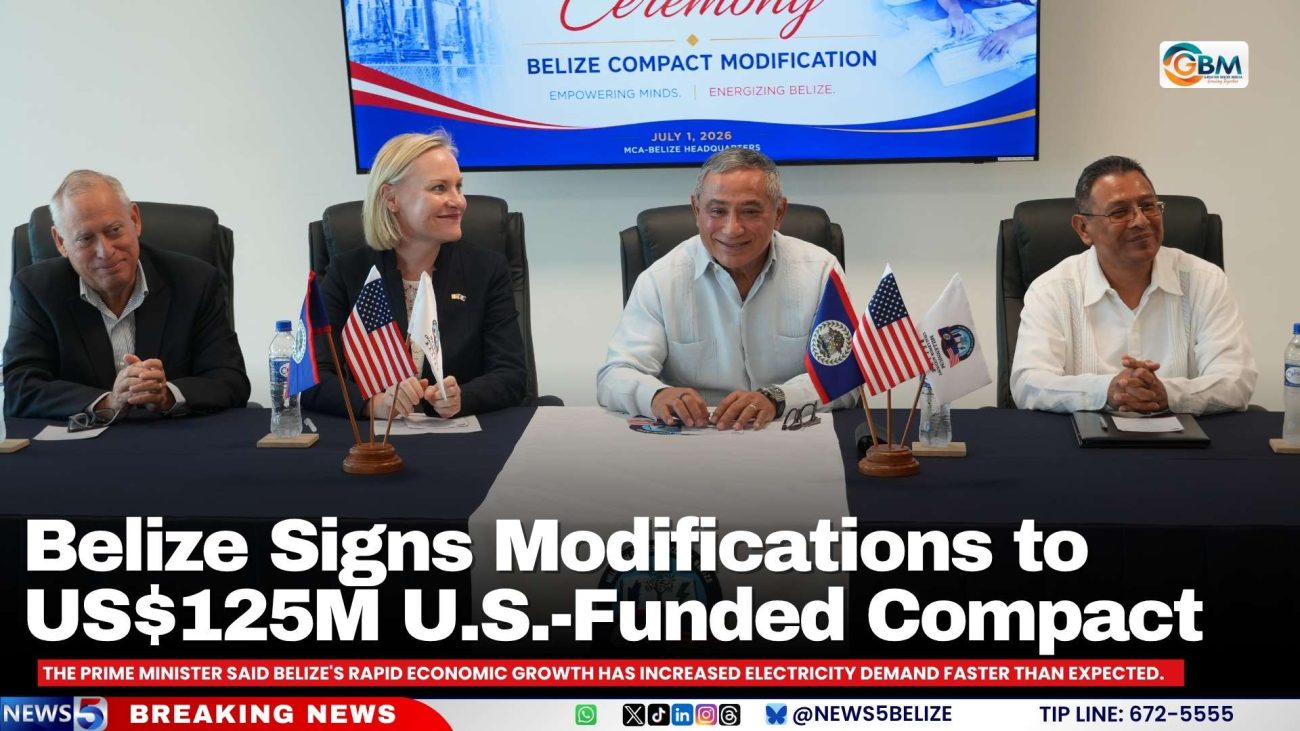
Belize Signs Modifications to US$125M U.S.-Funded Compact
The Government of Belize has formally signed modifications to its US$125 million compact with the US Government’s Millennium Challenge Corporation (MCC), redirecting more funding toward the country’s energy sector while maintaining major investments in education.
The agreement, one of the largest grant-funded investments in Belize’s history, was signed today by Carlos Pol, Chief Executive Officer of the Ministry of Economic Transformation, on behalf of the Government of Belize. Prime Minister John Briceño and other senior government and U.S. officials attended the signing ceremony.
The revised compact reallocates US$20 million from the Education Project to the Energy Project following a U.S. government foreign assistance review. The additional funding will support improvements to Belize’s electricity infrastructure, including the construction of a new 69-kilovolt submarine transmission cable to Ambergris Caye to strengthen the national grid and meet the island’s growing energy demand.
The Energy Project will also support reforms to modernise Belize’s energy policies and regulatory framework, including updates to the Belize Energy Act.
PM Briceño said Belize identified education and energy as its two top priorities when discussions with the MCC began in late 2021. “We know the two priorities that we had. One was education, and the second one was energy,” Briceño said, noting that consultations over the past several years helped shape the compact.
He added Belize’s rapid economic growth has increased electricity demand faster than expected. “In a way, we’ve been a victim of our own success. Our economy has grown way far faster than it was expected, so we are already consuming what was projected for 2028 and probably 2029,” he said.
Briceño explained that shifting additional funding to energy will help Belize improve the reliability of its electricity supply while working to reduce energy costs. “We’re trying to find ways on how we could start to bring down the cost of energy,” he said, adding that the government is also advancing battery storage and solar energy projects with support from the World Bank.
Despite the funding shift, the Education Project will continue focusing on improving secondary education, strengthening technical and vocational training, and enhancing workforce readiness. The Government of Belize will also increase its own financial contribution to both projects, including continued funding for digital learning devices for students.
The compact is expected to come into force later this year and aims to strengthen education while lowering the wholesale cost of electricity to support long-term economic growth in Belize.