


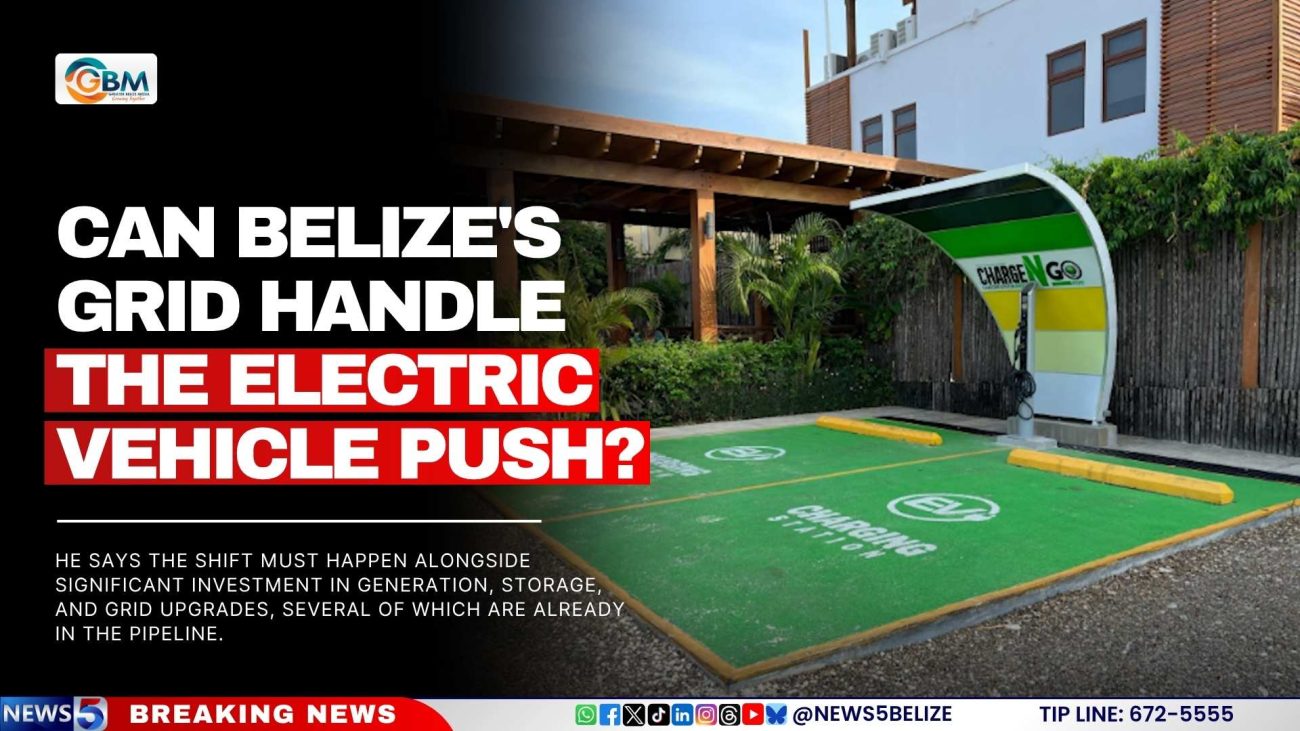
Can Belize’s Grid Handle the Electric Vehicle Push?
As Belize pushes to accelerate the transition to electric vehicles, one major question remains: can the country’s electricity grid keep up? With residents already raising concerns about power reliability and capacity, News Five asked Dr. Leroy Almendarez, Chief Executive Officer in the Ministry of Public Utilities and Energy, whether Belize has the infrastructure needed to support widespread EV adoption.
He says the shift must happen alongside significant investment in generation, storage, and grid upgrades, several of which are already in the pipeline. “That data tells BEL how much more we may really need because now you’re talking about charging stations plus your homes,” Almendarez said.
“I keep hearing people saying ‘the sun is shining,’ but you can’t just take the sun and put it in your vehicle. And I don’t mean to be cynical, but it simply means you must have infrastructure in place.”
According to Almendarez, Belize is further along than some may realize. The country is currently at the request-for-proposal stage for 80 megawatts of solar power, expected to come online in the first quarter of 2028. That will be paired with 40 megawatts of battery storage, both clean energy sources meant to help stabilize supply as demand grows.
In the shorter term, an additional 15 megawatts is expected from BABCOL by around November of this year.
But generating more power is only part of the equation, Almendarez said. The grid itself has to be able to move that electricity to where it’s needed.
“The grid must be able to dispatch that, to distribute that, to make sure that you can get access to that energy,” he said. “And you don’t want competing forces either. Otherwise, we’ll end up in a serious situation.”
Data presented at a recent briefing shows that the south of the country faces the greatest strain on the grid, a familiar concern for the region.