


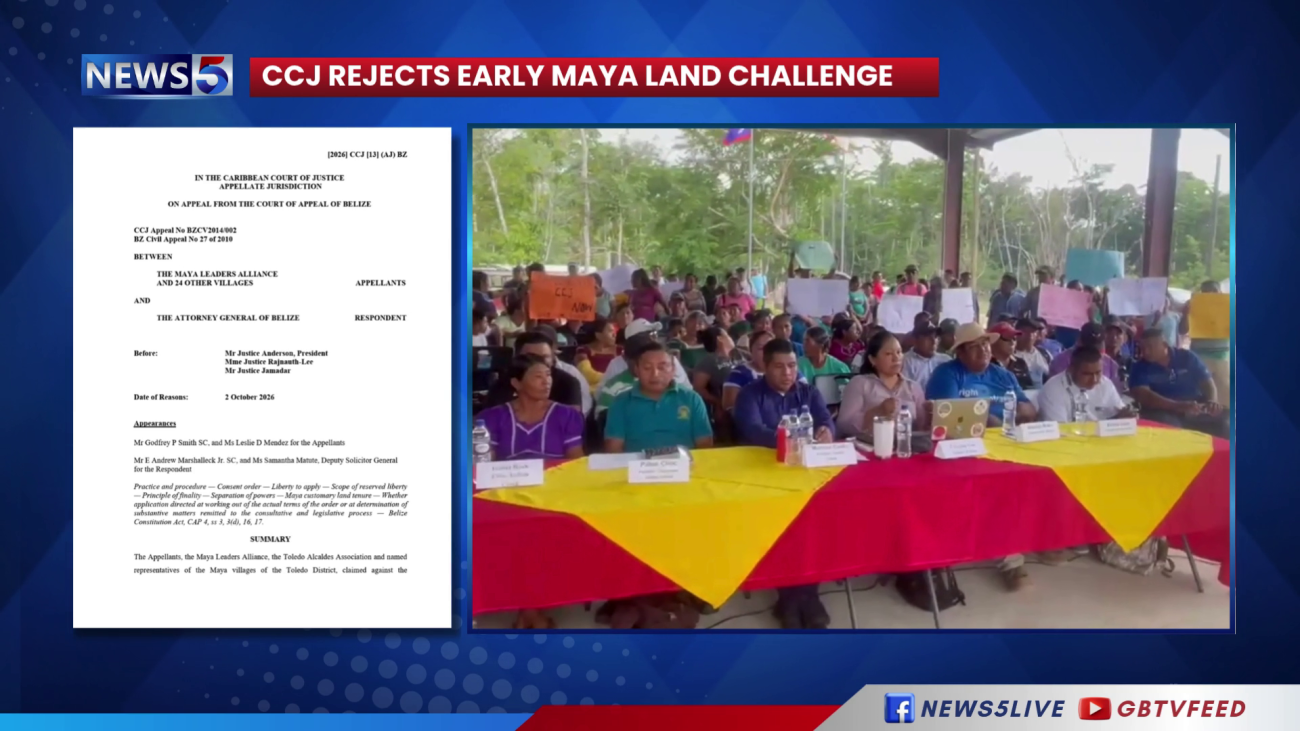
CCJ Dismisses Maya Land Rights Challenge but Leaves Door Open
The Caribbean Court of Justice has refused to step back into the long-running dispute over Maya customary land rights, ruling that it cannot decide the legality of a bill that has not yet reached the National Assembly. The case stems from a landmark 2015 Consent Order in which the Government of Belize formally recognized that Maya customary land tenure exists in the villages of the Toledo District. That agreement also affirmed that the system creates collective and individual property rights protected by the Constitution. Government committed to working with Maya communities to develop laws and other measures to identify and protect those rights. But the Maya Leaders Alliance, the Toledo Alcaldes Association and representatives of several Maya villages returned to the CCJ after raising serious concerns about the proposed Maya Customary Land Tenure (Recognition and Protection of Rights) Bill, 2025. They argued that several provisions in the draft legislation could weaken the very rights the 2015 order was meant to protect. Maya leaders warned that the proposed law could shrink village boundaries, impose a thirty-year land-use test and weaken community control over alcaldes and development projects. They asked the CCJ to step in, but the court refused. It said its role is to enforce the existing agreement, while government and Maya communities must settle the remaining issues through consultation and legislation. The CCJ says its 2015 order recognized Maya customary land rights but did not spell out how those rights should be defined or protected. The court says those details must be settled through meaningful consultation and legislation, not by judges rewriting the agreement. That includes decisions on village boundaries, proof of land use and communities’ power to reject development projects. The court therefore dismissed the application without awarding costs. The dispute, however, may not be over. If the draft bill becomes law, affected parties can mount a separate constitutional challenge. For now, the CCJ is urging both sides to keep talking and create protections that make Maya land rights practical tools for dignity and development, not “museum pieces.”
Attention readers: This online newscast is a direct transcript of our evening television broadcast. When speakers use Kriol, we have carefully rendered their words using a standard spelling system.
Watch the full newscast here: