


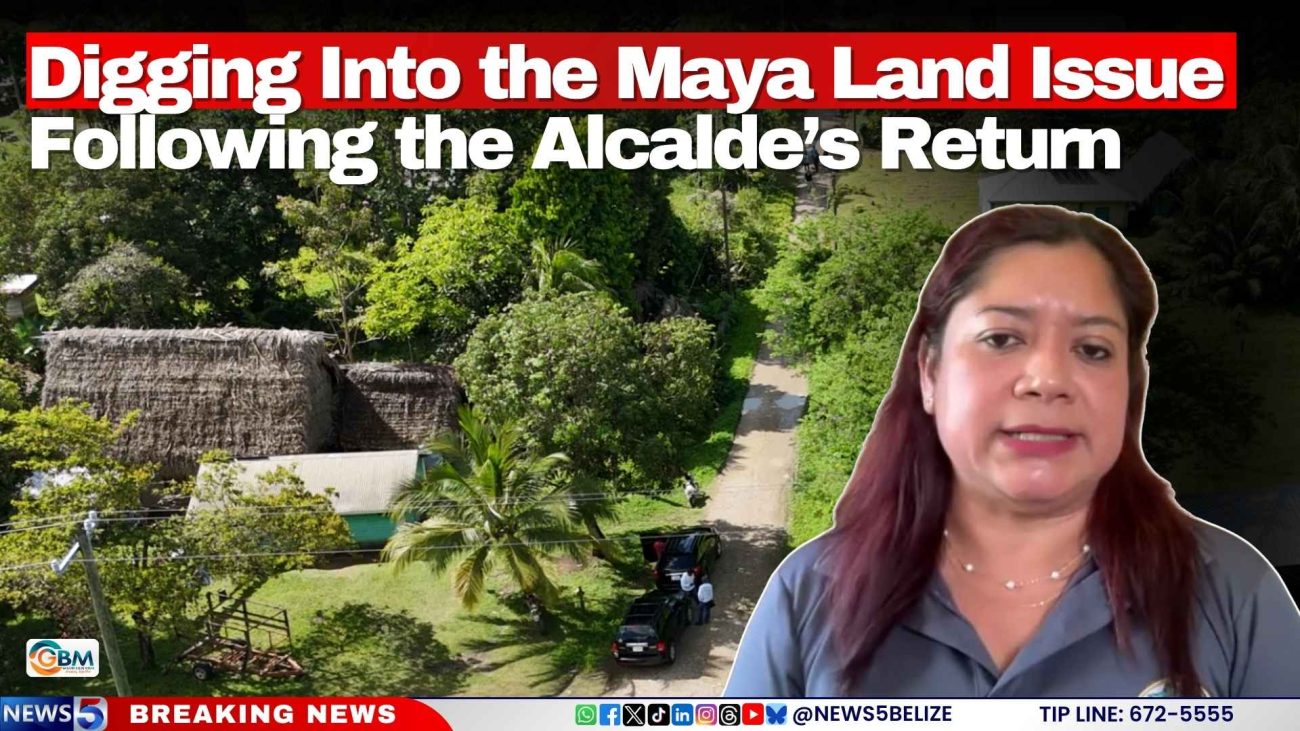
Digging Into the Maya Land Issue Following the Alcalde’s Return
The Sarstoon Temash Institute for Indigenous Management (SATIIM) is calling on the government to consult Maya communities before finalising new land tenure laws.
In a press release, SATIIM said the government has a legal duty to involve Maya villages in developing legislation on Maya customary land tenure. “That third-party landowners have had access to the draft legislation while Maya communities have yet to be consulted speaks volumes about the deep imbalance of power that continues to define this process,” the group stated.
SATIIM urged the government to share the full draft with Maya villages and begin meaningful discussions, warning that “misinformation and rumours are feeding mistrust, fear and tension in Southern Belize.”

Sponsored by RF&G Insurance
The Alcalde That Went Missing
The demand comes amid a developing situation in Indian Creek Village. On Tuesday, First Alcalde Marcus Canti vanished from his farm, triggering mob violence that damaged the homes of two community leaders. Canti later returned, telling police he was abducted by two men, and is now receiving medical treatment. Village Chairman Domingo Choc and Deputy Alcalde Manuel Ack were briefly arrested in connection with Canti’s disappearance but released after proving their innocence.
The incident has intensified long-standing disputes over land ownership.
In 2015, the Caribbean Court of Justice ruled that Maya customary land rights are constitutional and ordered the government to create legislation to protect them. Nearly a decade later, that law still does not exist. The National Garifuna Council also issued its own release standing in solidarity with Indigenous rights and calling for a “full and transparent investigation into the circumstances surrounding the alleged incident in Indian Creek.”
Minister of Indigenous People’s Affairs Dr Louis Zabaneh acknowledged this week that the legislative process has moved slowly, though he said a key review panel meeting is scheduled for April 24. In the absence of clear rules, Alcalde Canti issued what is believed to be 280 land certificates earlier this month on Boden Creek land. The government quickly declared the certificates illegal, saying alcaldes have no authority to grant land rights until legislation is in place.
A Private Land With a Long History
Ya’axché Executive Director Christina Garcia told News Five on Tuesday that the Boden Creek property has been in private hands since the 1950s, long before Indian Creek Village existed in its current form.
She explained that in the 1970s, a man named Harold Whitney bought the land and developed it for agriculture, employing workers who eventually became the early settlers of Indian Creek.
“There was never a settlement on the private property,” Garcia said. “Our research shows through satellite imagery that from the 80s, it shows a settlement coming into fruition on the eastern side of the highway, which is now the Indian Creek community.” According to her, these were people Whitney had hired to work on his land.
Whitney later sold the land in 1998, and it was eventually acquired by Flora and Fauna in 2019 for conservation purposes. Ya’axché came on board to manage the property in 2021. Garcia said the organisation made repeated attempts to open dialogue with both the village council and the alcalde but could never get the two sides on the same page, a reflection of the same internal divide that boiled over into violence this week.
The fundamental problem, Garcia said, is that no one, not the communities, not the private landowners, not the alcaldes or village councils, has any clear guidance on where the boundaries of the communities lie or what process must be followed. “There needs to be a clear position statement from the government in terms of how it is that we’re going to move forward with identifying these lands,” she said.