


Diplomat, Curator, Lawyer: What a UB History Degree Gets You
Think history is just dates and dusty textbooks? Delmer Tzib has heard that before, and he is happy to argue the point.
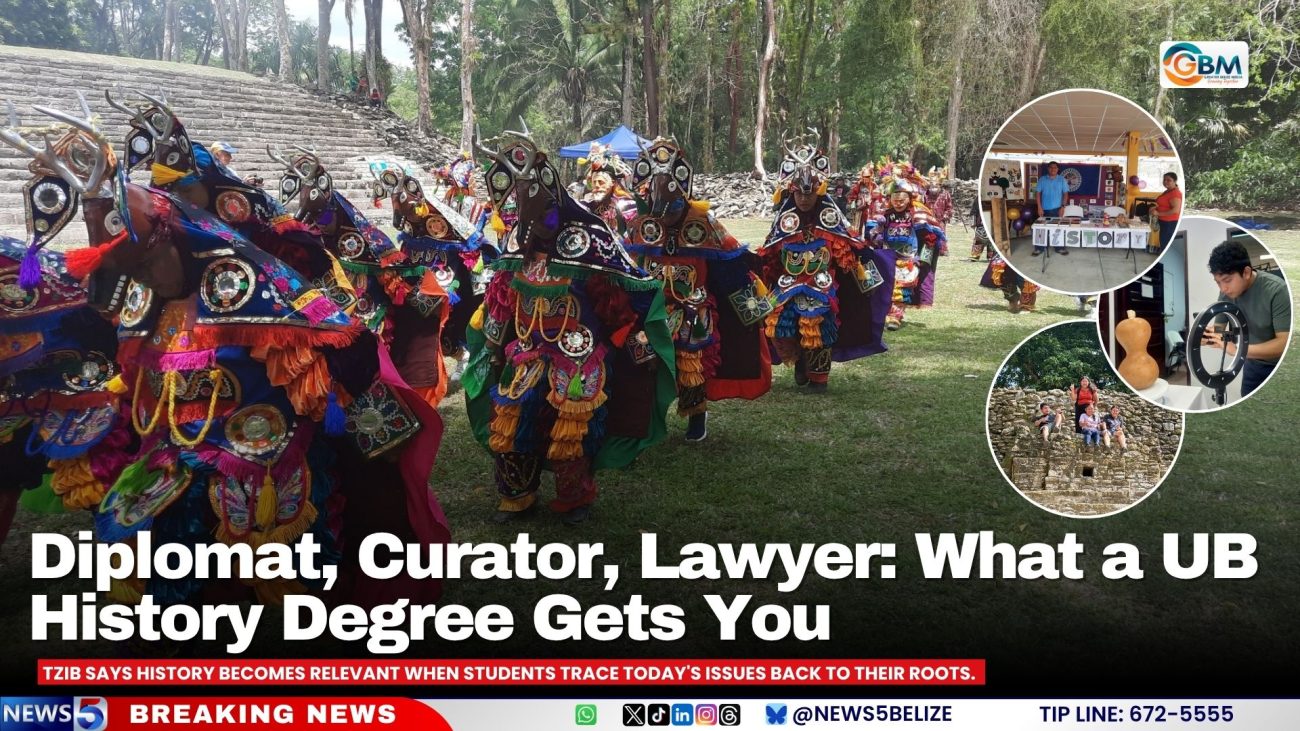
Tzib, a history lecturer at the University of Belize who also coordinates the university’s Intercultural Indigenous Language Institute, says the Bachelor in History programme is built around skills most students never expect to learn in a history degree. Students go into communities to record oral histories, dig through archives to test their theories, and learn to use media to tell the stories they find.
Why choose history over business or IT? Tzib didn’t flinch. “The history programme at the University of Belize is not only a programme that looks at the past, but it also looks at the present and the future. We are looking at assessing what some of the structures that were created that impact today are.”
“History boring”? Fair enough.
Tzib doesn’t dispute that plenty of people think history is boring. His answer is that the subject is only as dull as the way it is taught.
“History could be boring. Let me just put that out there. But just like any other subject, if you make it boring, it will be boring. It’s not boring to go into a community and hear how a community came about. It’s not boring to develop an exhibit and find different interpretations to a specific event.”
He describes history as an argument, not a list of facts. “Really, history is a dynamic process. It’s about controversies in history, looking at different interpretations of how people are looking at one specific event from different angles. ” He compared it to the work of reporters, who frame the same story differently depending on where they stand.
Diplomat, Curator, Lawyer: What a UB History Degree Gets You
What students actually do
Two projects show how that works in practice. In one, students and faculty went into the archives to trace the name “Belize” itself. They wanted to know what was said in the House of Representatives when the name was debated, what the government argued, and what the critics said. Tzib hopes to publish the analysis. “Something as big as the name Belize, but also as sometimes we take it for granted.”
In another, students work with the National Institute of Culture and History on an inventory of food heritage. They go into communities, ask people which food practices they keep and which are at risk of disappearing, and document the steps and why they matter.
The archives also show that Belize’s road to independence was not as smooth as the “peaceful country” label suggests, Tzib says. “It was not devoid of conflict. People were for and against. There were people who were saying that perhaps we should wait a little bit longer until we settle the Guatemala dispute, while others were saying, ‘No, we need to go straight into independence.'”
How different would Belize be if independence had come later? Tzib turned the question around. “When would we ever have been ready? Who determines what would have made us ready?”
The programme’s materials list the hands-on side in more detail: fieldwork, internships at museums and archives, oral history projects, and digital storytelling. Students also train in archives and records management, museum exhibit design, digital mapping (GIS), and podcast and multimedia production.
Why it matters to a 19-year-old in 2026
Tzib says history becomes relevant when students trace today’s issues back to their roots. He gave the example of early land rules in the settlement. “Who are these laws for? Why were they being created? Then we come back to today, and we begin to assess what the policies that are in place are. Who created them? Who are these for?”
He pointed to the debate over removing the Crown from the money as another example. He also says history is no longer a stand-alone subject. “History is now being coupled with technology. AI is also being employed for historical discussions. You also have history being used for movies, for the creation of video games, and in informing how graphic work is being done. It is a very dynamic field that can provide you with skills that go beyond history.”
He wants history to leave the classroom. “I often cringe a bit when I hear that Emancipation Day comes and people are asking, ‘So what is emancipation?’ We need to do better as it relates to creating more information and making it more available.”
Diplomat, Curator, Lawyer: What a UB History Degree Gets You
Where it can take you
The programme’s materials say graduates work in:
- Education: Belizean Studies teacher, curriculum developer, lecturer
- Heritage and museums: curator, archivist, cultural resource manager, museum educator
- Tourism: heritage tour developer, cultural interpreter, tour guide trainer
- Public service: policy analyst, researcher, diplomat, foreign service officer
- Creative industries: cultural programmer, content developer, historical consultant
- Entrepreneurship: heritage-based business owner, cultural events manager
- Further study: graduate degrees in history, public history, archaeology and law
Tzib says the graduates are already out there. “We have diplomats. We have people who did their bachelor’s in history and then went on to do law. We had people who went on to anthropology and archaeology. And of course, there are a lot of people who went into education, like myself.”
He says it is the only bachelor-level history programme in the country and that it is aligned with social science, which he calls a base that “could be the base for anthropology, for diplomacy.”
The programme’s pitch is blunt. “History is the blueprint of national development; you cannot build a future you don’t understand.” It adds that “the past isn’t just a prologue; it’s profit, policy, and power.”
How to apply
- Deadline: Admissions are open now and close the last week of November.
- Length: It is a 120-credit programme that takes three and a half years, or three if you take one or two summers.
- Format: It is blended, with online classes and fieldwork in person, and is offered at the Belmopan campus.
- Who can apply: High school graduates can apply directly. Junior college transfers with an associate degree and a cumulative GPA of 2.0 or above are eligible, and Tzib says the university tries to transfer as many credits as it can and is working with junior colleges on a smoother transition.
- What to send: An official transcript, standardised test scores if applicable (ATLIB, CXC, SAT, ACT or GCE), two UB recommendation forms, a passport-sized photo, and certified copies of your Social Security card, passport or birth certificate, and high school diploma or associate degree, along with the application fee receipt.
- Support: The programme lists a dedicated coordinator, student monitoring, and scholarships.
- Contact: 822-3680, admissions@ub.edu.bz, Hummingbird Avenue, Belmopan. Transcripts can be emailed to etranscripts@ub.edu.bz.