


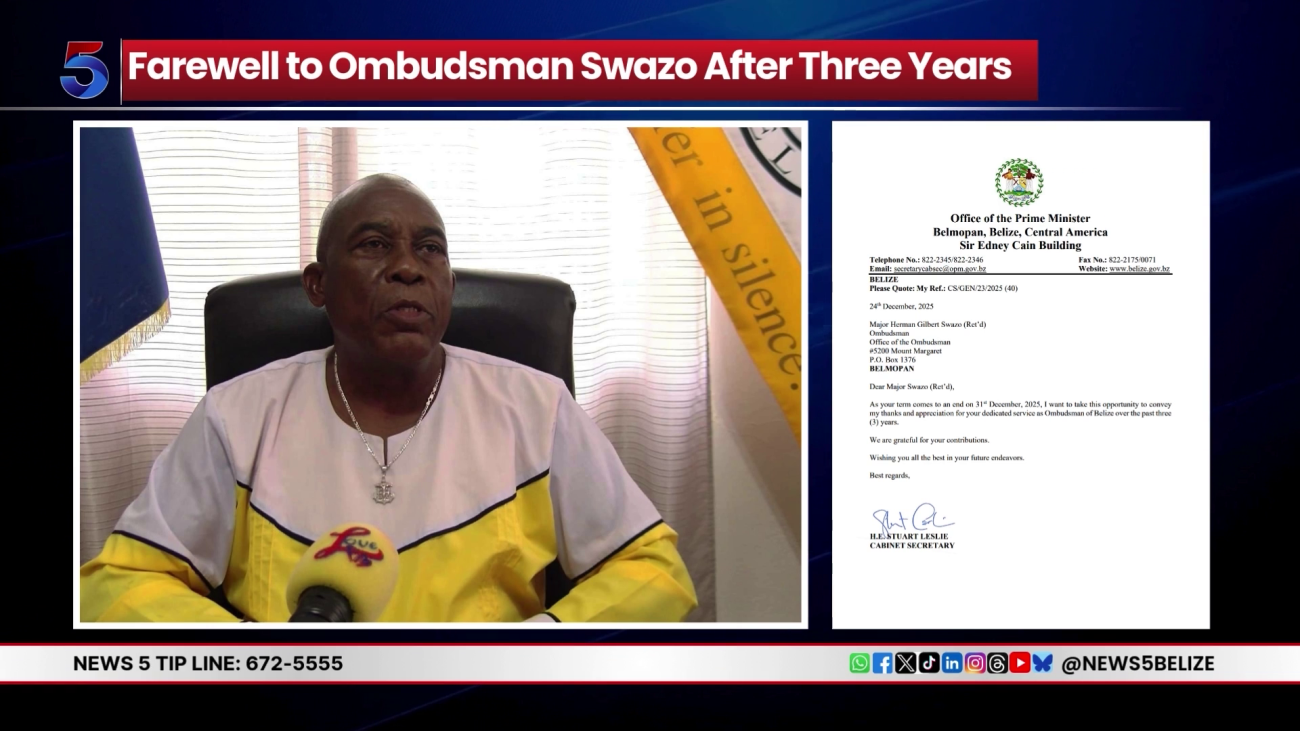
Government Defends Status Quo as Court Battle Over Ombudsman Heats Up
A legal showdown is brewing over who’s really protecting the public’s interests and who isn’t. Former Ombudsman Gilbert Swaso is taking the government to court, accusing it of weakening oversight by leaving the post vacant for six months. At the heart of the issue is independence because without its own legal team or budget, the Ombudsman’s office must rely on the Attorney General, even in cases where the government itself is under scrutiny. Swaso warns that leaves the office stuck in limbo whenever its decisions are challenged. But Attorney General Anthony Sylvestre disagrees, maintaining there’s no problem with the current setup and offering his explanation for the prolonged vacancy.
Anthony Sylvestre
Anthony Sylvestre, Attorney General
“What should happen is that that request should be made through the clerk of the National Assembly’s office, and in turn, that would be transmitted to the financial secretary. But, as I had explained, I see no difficulty, no reason, and no issue why the office should not have an independent counsel.”
Reporter
“Do you know, though, if an independent counsel has actually already been retained because filings have started already?”
Anthony Sylvestre
“I have no idea. I mean, we’re separate. We’re not to be notified. But the matter does come up in court. so, at that point in time, I do believe that that issue should be addressed.”
Reporter
“You don’t know the dates, like when next?”
Anthony Sylvestre
“I think it’s next week, if I’m not mistaken. As explained by the honorable Prime Minister, the office still exists. We still have all the different officers of the office and that, and those functions, still can be addressed. There is really and firstly, let me say the delay, which is regrettable in terms of the appointment of the ombudsman it is not something that, that certainly we wanted. It’s as a result of the process that now follows incorporating a National Human Rights Institute in the Office of the Ombudsman. So as you well know, the Office of the Ombudsman has already, already has a large number of functions in addressing citizen complaints with respect to maladministration and so on and so forth. The proposed creation and establishment of a National Human Rights Institute is one which would further extend the functions and responsibilities of the Ombudsman office.”
The Attorney General says the Ombudsman operates independently and must request its own funding. If legal help is needed, the office has to go through the National Assembly, routing the request from the Clerk to the Financial Secretary, because it’s a parliamentary body, not a government department.
 Planned Reform Sparks Backlash as Ombudsman Office Remains Vacant
Are government reform efforts strengthening oversight, or weakening it in the meantime? That’s the question now at the center of a growing debate over the long-vacant Ombudsman’s office. Attorney General Anthony Sylvestre says the delay is intentional, tied to plans to transform the office into a National Human Rights Institution, a move that requires changes to how the role is structured and who can fill it. But critics say the absence of an Ombudsman, even in an acting capacity, is leaving the office without independent legal muscle and slowing key investigations. While Sylvestre insists progress is happening behind closed doors, concerns are mounting that accountability is taking a hit in the process.
Anthony Sylvestre
Anthony Sylvestre, Attorney General
“There is a working team that has been established, which includes both private sector social partners and persons from various government ministries. My understanding is that they meet on Monday to continue that process in terms of trying to formalize how do we do this. Because what will necessarily ollow from this is that the qualification of the ombudsman will need to change. So these are things which, which regrettably and unfortunately have delayed the process. But what I can say is that we’re moving as fast and as quickly as possible, obviously not to the satisfaction, understandably so of persons who are, who are concerned. But I can say unquestionably that We are moving and that we seek to address this issue, as soon as possible. But there are issues which are outside the scope and the determination of the government at this point in time. The functions the additional duties of the ombudsman if a national human rights institute is to be incorporated will be extremely, extremely, it’ll be more than double the work what currently exists. That is a suggestion that certainly can be taken on board. But the point is that in terms of how the office will proceed moving forward, that is a de-determination that is being made, not by government, but as I explained to you, a number of persons, including civil society. Because there is, there is nothing to begin by moving fast, establishing an office passing legislation with what is thought to be or is hoped to be something that will work, and it can’t work.”
The government says people can still file complaints, but critics question how far those cases can go without an Ombudsman in charge.
Attention readers: This online newscast is a direct transcript of our evening television broadcast. When speakers use Kriol, we have carefully rendered their words using a standard spelling system.
Watch the full newscast here: