


How Do You Watch a Movie You Cannot See? Eighteen Blind Children Just Showed Us
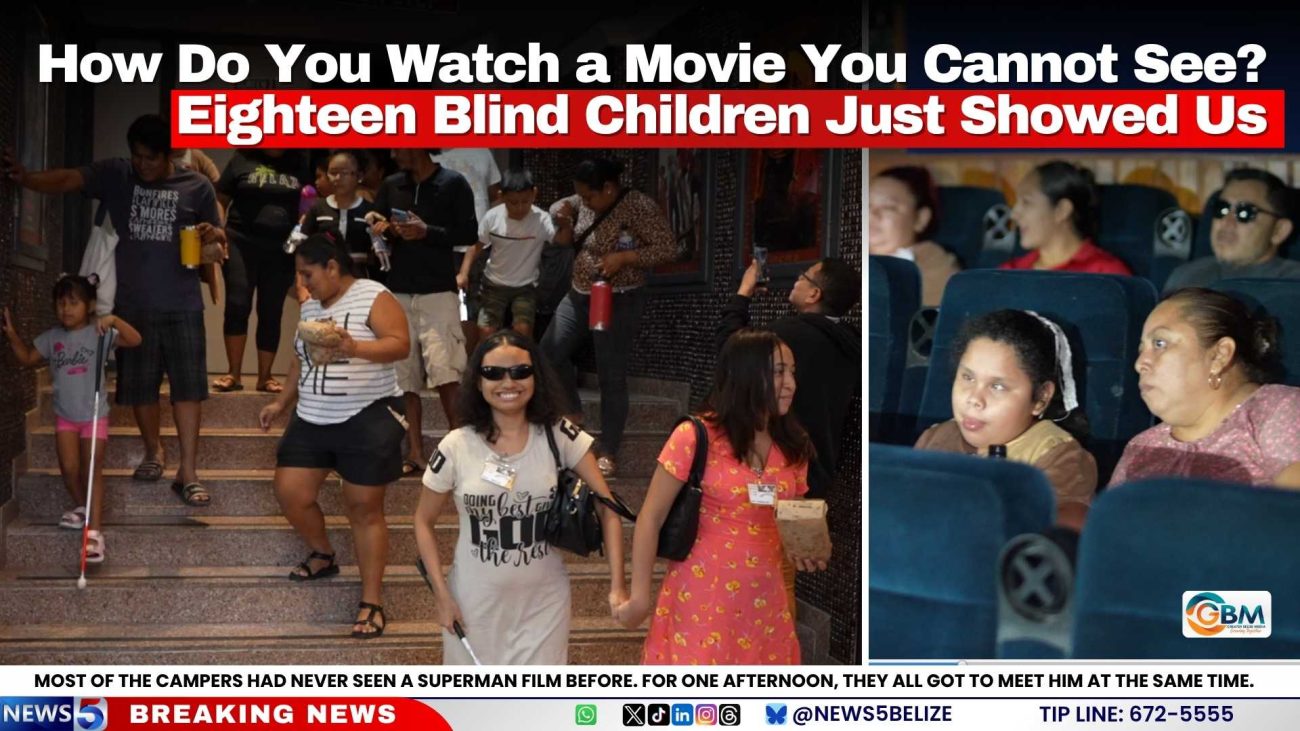
The smell of popcorn hit first. Then the cold rush of the air conditioning. Then the sound, rising all around, of eighteen children finding their seats.
At the Ramada Princess Theatre in Belize City last Thursday, that was how the movie began, long before the screen lit up.
They were campers from the Belize Council for the Visually Impaired’s (BCVI) annual summer camp, in the city for a week of Braille lessons, art, music and drumming. This year, for the first time for many of them, the schedule included something that sounded almost impossible. A trip to the cinema. To watch Superman (2025).
They could not see the cape. They could not see Krypton or Metropolis or the actor’s face. And it did not matter. Because a child who cannot see a movie can still live inside one.
An Experience, Not a Screening
How Do You Watch a Movie You Cannot See? Eighteen Blind Children Just Showed Us
Before they took their seats, the campers lined up for popcorn and juice donated by Princess Ramada Theater. Families walked alongside them, some holding hands, some describing the room out loud without even being asked.
Then they went in to watch the film.
Except “watch” is not quite the right word. Each child sat beside a parent, a sibling, a friend, or someone whose job for the next two hours was to become their eyes. Whispering what was happening on screen. Filling in the gaps between what the ears could catch and what the imagination could build.
I decided I needed to understand what that actually felt like. So I put on a blindfold and tried to watch the movie the way they did, leaning on sound, on the shift of the seat beside me, on the reactions of the children around me.
It was an eye-opener in every sense but the literal one. And it left me with something simple and something enormous at once. These children are brave. Every one of them has learned to live fully in a world that keeps assuming sight is the only way in.
Building Confidence, One Camp at a Time
Carla Ayres-Musa, Executive Director of BCVI, has watched this camp grow for years.
“Summer camp is just one week out of the year,” she said. “BCVI’s rehabilitation programme works with people throughout the country who are blind every single day of the year. So summer camp is focusing on children who are in school, and we’re getting them ready for the upcoming school year, but we’re also helping them socialise and adapt and live independently.”
This year’s camp had eighteen children, ranging from those still working toward the school-age cut-off to older students in sixth form who receive one-to-one support.
Ayres-Musa explained how a child who cannot see still experiences a film in full.
“People who are blind will utilise their other senses to do things that we do with our eyes,” she said. “So their other senses are enhanced. If you imagine the smell of popcorn, the feeling of the air conditioning, and the cosiness of the chairs. You think about the sound effects that you’re receiving. We make sure that we have a sighted person, a volunteer, a family member or a staff member who sits with our client to ensure that if there’s any part of the movie where we need to describe what’s happening, we’re able to do that.”
Some apps now offer audio-descriptive narration built in. The cinema does not, so BCVI builds that support into every seat.
“Everyone thoroughly enjoyed it,” Ayres-Musa said. “When we look at summer camp and we look at rehab and the activities that we do, our focus is to ensure that we’re building that confidence, we’re building independence, and we’re building friendships. Experiences like this are made possible because our community continues to believe in that inclusion. We’re really thankful for partners like the Ramada Princess Cinema, who help to make our children feel seen and feel included.”
Most of the campers had never seen a Superman film before. For one afternoon, they all got to meet him at the same time.
Valenie’s First Time
How Do You Watch a Movie You Cannot See? Eighteen Blind Children Just Showed Us
Eighteen-year-old Valenie Coc was at camp for the first time this year. She and her father, Valentino Coc, travelled from Punta Gorda to be part of the camp.
“The camp has been good,” she said. “It’s fun. I have met new friends; the people I talk to are nice and good to talk to.”
Superman, it turns out, was already a name she knew and liked.
“Superman is something that I like,” she said. “A hero is a good person, and it’s very exciting to watch about it.”
Valentino sat beside her in the theatre, ready to describe the action as it unfolded. He barely got the chance. “I tried to explain the movie to her,” he said, “but even before I explain the movie to her, she already knows the movie. Yeah, because she already saw them. She even knows more, because she was mentioning, ‘What kind of movie is this? Is it Batman? Is it Spider-Man?’ And I tell her no. She knows more than me.”
Valenie lost her sight gradually, starting in one eye and then moving to the other, during her final year of primary school. Last year, at this same time, she and her father were in Belize City for camp, and she missed her own standard sixth graduation.
“She was just in pain that time,” Valentino said quietly.
A year later, the same trip to the city looks completely different.
“For me, it’s very good because it’s a time when Valenie can socialise,” he said. “She has met quite a number of people. I’ve seen Valenie making jokes with some of her colleagues. For me, it is an experience that I have never experienced, and I enjoy it. I enjoy it, meeting a lot of people too.”
At home, the family is adjusting in its own quiet way. Valentino has another child who is also visually impaired.
“We have to give her more attention because she needs help in almost anything,” he said. “She’s gradually learned where the other things are at home. And slowly, slowly, she is getting independent now.”
What Valenie Wants Other Children to Know
How Do You Watch a Movie You Cannot See? Eighteen Blind Children Just Showed Us
“I want them to know not to be afraid,” she said. “To enjoy what they have right now.”
And what does she want for her own future?
“I want to be helping others as well who are blind,” she said. “And teaching a lot of good stuff.”
Ayres-Musa put it best. Walking into a theatre, picking a seat, holding warm popcorn in your hands. These are small things most of us never think twice about. For these children and their families, each one was a whole moment, lived through fully, together.
Superman flew across that screen for two hours. But the real story was in the seats. In fathers leaning close to describe a fight scene, their daughters had already guessed correctly. Siblings laughing at the same jokes. For eighteen children who could not see the movie and did not need to, for one afternoon, they were simply kids at the movies with people who love them.
That, more than any superhero on screen, is what BCVI’s summer camp is really about. Not fixing what is different about these children, but making room for them to be exactly who they are, fully, loudly, and without apology.