


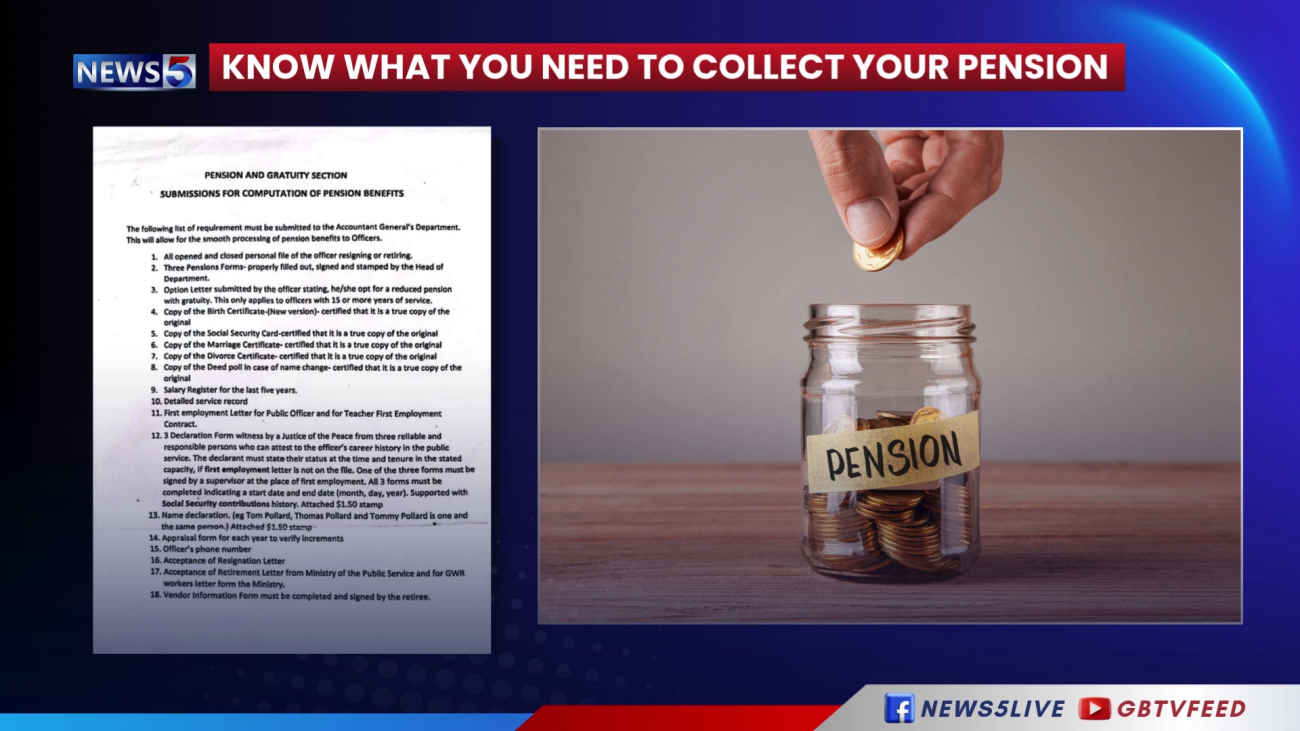
How Public Officers Can Protect Their Pension Benefits
For many public officers, receiving pension benefits is a process that begins long before retirement. Ensuring the right documents are on file and addressing any missing records early can play a major role in how smoothly benefits are processed once an employee leaves the public service. With ongoing concerns about pension delays, attention is now turning to the proactive steps employees and administrators can take well ahead of retirement to prevent complications. Today’s News Five’s Britney Gordon breaks down what Belizeans can do to ensure they receive their pension benefits following their retirement.
 Britney Gordon, Reporting
Retirement is a milestone many public officers spend their careers working toward, with pension benefits expected to provide financial stability in their post-service years. But for many, the process has become chaotic and tiresome. Attorney Richard “Dickie” Bradley raised concerns over the efficiency of the process.
Richard “Dickie” Bradley
Richard “Dickie” Bradley, Attorney-at-Law
“People die and no seeing pension. What kind of country we run?”
While many report that the process has not been easy experts say that receiving those benefits smoothly depends on careful planning and record-keeping long before retirement arrives. According to Carol Gentle, a retired administrative officer who worked in public service for nearly four decades, preparing for retirement is a shared responsibility between the employee and the administrative officer.
Carol Gentle
Carol Gentle, Former Admirative Officer
“The employee have a right to ask to see his or her file whenever they choose. I, as the administrative officer, I recommend to public officers, when you reach the age of, say, between fifty to fifty-three, you try and find your administrative officer and ask them to set a date for you to go through your file, because you have that, you have that right to see your file. You peruse your file, check to see what’s on your file, and ask questions.”
Gentle explained that public officers must ensure their pension files are complete before retirement, including documents such as approved leave records, updated birth and marital status certificates, and all required performance appraisals.
 Carol Gentle
“You have to ensure that all your performance appraisal, both mid-year and end-of-year, is on your file. If it is not, it is you the officer’s responsibility to ensure that your supervisor do your appraisal and have it affixed to your file. Even if you’re at the end of your pay scale, it’s your obligation to get it done or else your, your file will not be processed when you are not fifty-five. When you are fifty-four, your file start to process one year before.”
Among the most common challenges are missing employment records, incomplete performance appraisals, and discrepancies in personal documents, all of which can slow the computation of pension and gratuity benefits.
 Carol Gentle
“I found in my experience a lot of people are in the public service with one name, and for some reason when they go to the vital statistics for their birth paper, they are registered in a different name. They have to go through the process, and that’s why I advise them that they get their birth paper way in advance, years in advance.”
Gentle says employees should not wait until retirement to check their files. Annual audits help confirm that all required documents are in place, and if anything is missing, officers have time to fix it before their retirement package is submitted. Britney Gordon for News Five.
Attention readers: This online newscast is a direct transcript of our evening television broadcast. When speakers use Kriol, we have carefully rendered their words using a standard spelling system.
Watch the full newscast here: