



Sargassum Surge Pushes Belize Toward Crisis
Sargassum is piling up fast along Belize’s coast, pushing the country closer to a full Red Phase. Thick seaweed is smothering beaches, hurting tourism and marine life. In San Pedro, crews now work daily with more equipment and larger teams, clearing shorelines and setting up compost sites, but it’s still not enough. Authorities are scrambling to secure long-term dumping areas and safer solutions with conservation partners. With the situation worsening, pressure is mounting to step up the response. Officials admit some days, despite all efforts, the battle feels like it’s being lost.

Anthony Mahler
Anthony Mahler, Minister of Tourism
“Some days, because I don’t think we’re looking at this, heavily as a region, and I push it personally in both meetings for Central America and, and the, um, Caribbean. Uh, but I don’t think we have worked on this collectively and with science behind it to see how we can deal with it. Thee scientists say that it’s coming out of the Amazon and then, out of the Sargasso Sea, and a whole pile of things. So we just have to try it. If you can see Playa del Carmen, we got lucky over the last month or so. Most of it went up to Mexico, and they are taking a beating right now, and they have much bigger budgets, and they have the Coast Guard working and all kind of thing to try. And it still just keeps coming because you can’t work 24/7 in that environment, so by the time you wake up in the morning, a boatload or a beach load of sargassum has washed up on the beaches.”
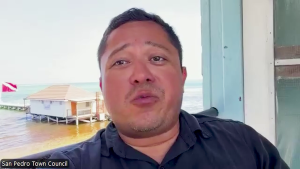
Valentine Rosado
Valentine Rosado, Science Advisor, San Pedro Town Council
“The sargassum, when it gets close to the shoreline, it also becomes influenced by the atmospheric conditions. So we look at the weather, we look at the wind, we look at the tides, and then this also kind of helps us to understand what quantities we’re gonna get and where. Because if we’re able to kind of predict the quantities, then we know the amount of staff that we need to have and which locations are the ones where we have heavy accumulations. So if they manage to control one area, then probably it’s time to kind of move them and, and deal with some other areas. But it’s just huge quantities of sargassum and at least for San Pedro Town, we’re focusing in town, which is only, like, about about one mile. And outside of this, then you have different properties, businesses, and resorts that they have their full response program as well. Unfortunately, that’s not everyone, it’s just a few here and there. Because if every property owner, like, looks at their specific area and cleans up, we can actually manage this, but the problem is that we have a lot of property owners that are not doing anything. They’re not cleaning up and it’s just the few, right? So part of our effort as well is to try to encourage the ones that are doing because they tend to get disappointed every year. They’re like, “We’re tired, we’re still losing our equipment, our staffs, is having health problems. It’s costing us a lot of money.” and then we’re still not seeing clear days, right?”
Belize has begun using the stoplight system which shows when local crews are at full capacity and need additional help, highlighting that sargassum is now a year round challenge demanding ever growing resources.
Attention readers: This online newscast is a direct transcript of our evening television broadcast. When speakers use Kriol, we have carefully rendered their words using a standard spelling system.
Watch the full newscast here: