



The High Cost of Scarce Procurement Expertise
Rey Guerrero’s contract may carry a price tag of more than three hundred and eighty thousand dollars, but the controversy has exposed a much bigger problem. Belize does not have enough procurement specialists to manage its growing portfolio of government projects, and the public service is struggling to hold on to those already trained. Shane Williams reports.
 Shane Williams, Reporting
A salary of one hundred and sixty thousand dollars a year, plus allowances and a twenty-percent gratuity, has placed Rey Guerrero’s contract under intense scrutiny. But while the price tag is driving the controversy, it also exposes a deeper problem: Belize does not have enough qualified procurement specialists to manage its growing portfolio of government projects. And when that expertise is missing, roads, schools, hospitals and other major investments can remain stuck on paper while taxpayers absorb the cost.

Dean Flowers
Dean Flowers, President, Public Service Union
“You’re bringing somebody in from outside, and you’re giving him $160,000 base salary over two years with 20% gratuity. 20% gratuity. And we have to ask ourself, why aren’t we creating a permanent procurement unit staffed by well-qualified public officers insulated from political interference to ensure that the Belizean people get value for money?”
 Dean Flowers argues that government should build a permanent team within the public service rather than rely on expensive individual contracts. But Prime Minister John Briceño says Guerrero’s workload is anything but ordinary. He oversees procurement for more than three hundred million US dollars in projects, many financed by international institutions with strict rules governing how that money is spent.
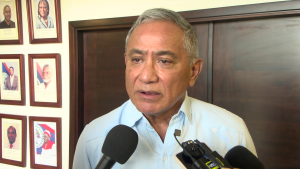
Prime Minister John Briceño
Prime Minister John Briceño (File: October 2, 2026)
“Mr. Guerrero manages over three hundred plus million US dollars worth of projects. And they have high—they have set some very stringent requirements as to how we do about going about with procurement. So that is a part of the agreement that we have. Now, Mr. Guerrero has the central execution unit but also apart from that, he’s also in charge of the procurement unit, so he has double the amount of work.”
 The Prime Minister says he would rather see more Belizeans qualified to take on those responsibilities. The challenge is finding them. Fewer than ten Level Four procurement specialists currently work in the public service. Those officers hold graduate-level qualifications in a field that government increasingly relies on to turn development financing into completed projects. For years, finance officers have also handled procurement duties, even though the two roles require different skills. Government is now trying to close that gap by training more specialists.

Osmond Martinez
Dr. Osmond Martinez, Minister of Economic Transformation
“We even spoke about how to continue to train procurement officers so that they can become procurement specialists and to widen the pool of, uh, of, um, specialists so that we can have a more efficient implementation of the projects.”
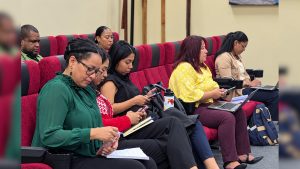 Twenty-nine new procurement officers are certified and ready to help revive long-delayed projects, if government can retain them. An entry-level procurement officer may earn between thirty-six and thirty-eight thousand dollars annually at Pay Scale Sixteen. The same officer could potentially secure a project contract paying more than ninety thousand dollars. Yet even the higher salary may not be enough to keep a specialist in place when another project offers greater job security.
Dr. Osmond Martinez
“Some of the good procurement specialists, that are exceptional, what will happen is that they are on project A working, and the lifetime of that project is five years. But when they reach the project three, to year three of that project, another project might come up with a new five years’ time. So they will easily jump out from that project and move on to another project because they will have job security of another five years rather than two years.”
 That means government is not only competing with the private sector. Its own projects are also competing against one another for the same small group of specialists. And as the number and value of development projects increase, so does the pressure on those officers. One procurement officer may handle two projects, while another at the Ministry of Education juggles more than a dozen worth tens of millions of dollars. Without qualified oversight, those projects can stall.
Dr. Osmond Martinez
“We have seen projects that take up to ten years. There was one that was designed in twenty ten approved in twenty fourteen, and we’re still implementing that project and it should have been a five years period.”
Those delays cost more than time. Government may face commitment fees on financing it has not used, even as interest continues to accumulate. That brings the debate over Guerrero’s contract back to a difficult question: is paying hundreds of thousands of dollars for one specialist excessive, or is it a necessary investment to move hundreds of millions of dollars in projects? Shane Williams for News Five.
Attention readers: This online newscast is a direct transcript of our evening television broadcast. When speakers use Kriol, we have carefully rendered their words using a standard spelling system.
Watch the full newscast here: