


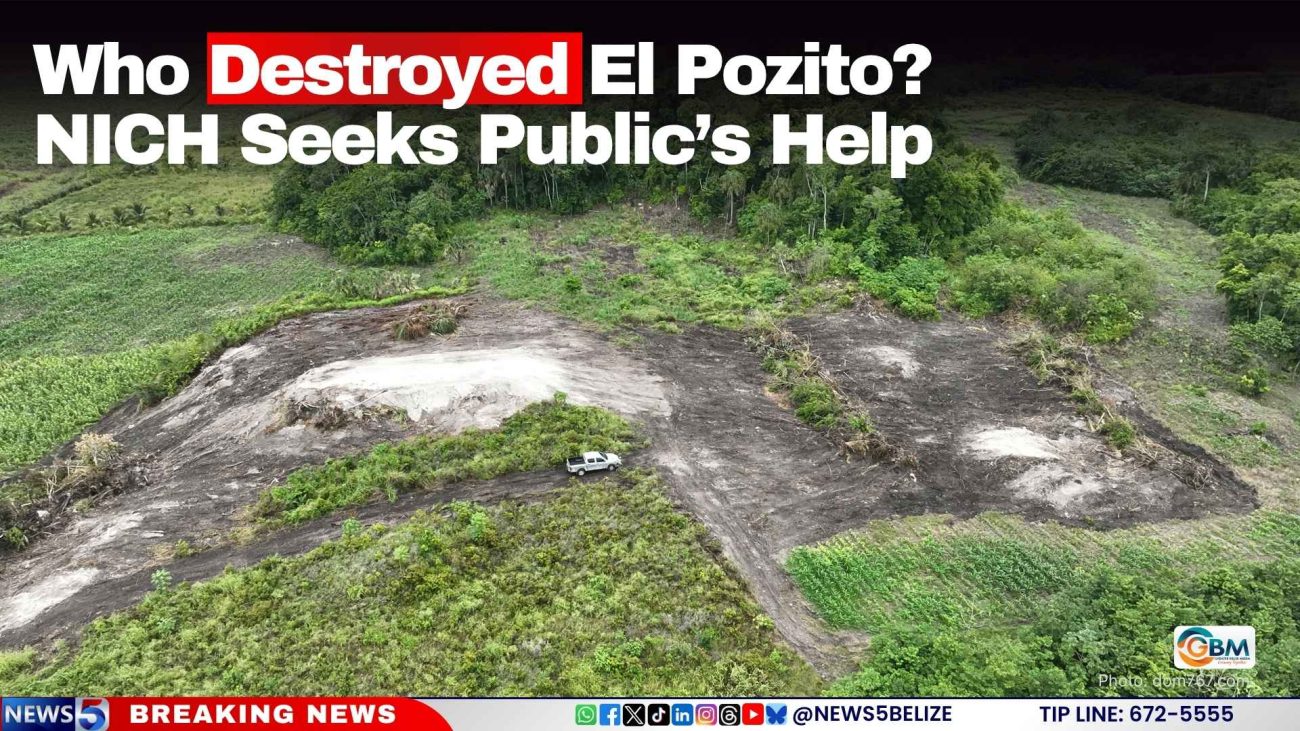
Who Destroyed El Pozito? NICH Seeks Public’s Help
The National Institute of Culture and History (NICH) is seeking the public’s help to identify those responsible for the destruction of an ancient archaeological complex at El Pozito, near Guinea Grass Village in the Orange Walk District.
The Institute of Archaeology (IA) discovered the destruction of Complex D and associated structures during an inspection on Monday.
“The findings on 17 August 2026 of the site destruction were disheartening. The findings reaffirm the need for the public’s support in protecting and preserving Belize’s archaeological resources. These sites form an integral part of our national cultural heritage, and it is only through joint effort, built on national pride, that we can ensure their protection,” NICH said in a statement.
According to NICH, the site has been under close monitoring, with inspections intensified after land clearing near the site core had already partially damaged some structures. The IA also recently partnered with the College of East Texas on archaeological research at El Pozito, led by Principal Investigator Dr Keith Eppich.
The first research season was conducted during the summer of 2026 to update the site’s 1976 map and prepare for future research.
NICH also reminded the public that deliberately damaging, destroying or disturbing an ancient monument is an offence under the National Institute of Culture and History Act.
Anyone convicted can face a fine of up to $75,000, imprisonment for up to five years, or both.
NICH is asking anyone with information to contact the nearest police station, its Senior Archaeologist by email, or via WhatsApp on 601-7292 or 672-4190.