


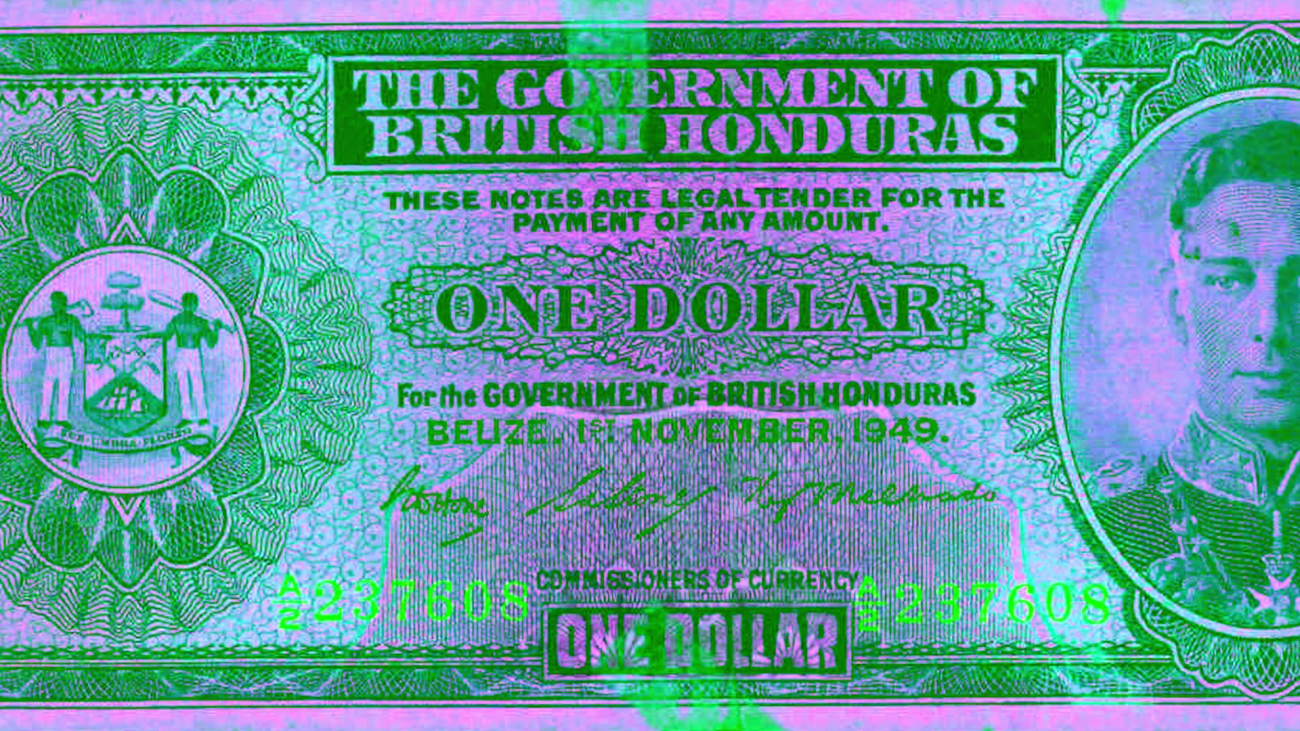
The Story Behind Belize’s Two-to-One Money Peg
For fifty years, one ratio has remained a constant in Belize’s economy, two to one. Since 1976, the Belize dollar has been fixed at two Belize dollars to one U.S. dollar. But that stability did not happen overnight, and this rate was not always the same. The story of Belize’s currency stretches back more than a century through British rule, changes in the international economy and a decision that would shape Belize’s financial system for generations. News Five’s Shane Williams Reports.
 Shane Williams, Reporting
Before there was an independent Belize, there was British Honduras and its currency was already looking strong. Before 1894, multiple foreign currencies circulated in Belize at values that fluctuated with silver prices. This created trade and economic uncertainty in the colony.
Emory Ford
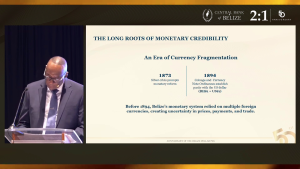
Emory Ford, Chief Economist, Central Bank of Belize
“The reforms introduced that year replaced this fragmented arrangement with a unified monetary framework. In October 1894, the Coinage Ordinance established the gold dollar of the United States as the monetary standard and created a common unit of account for the colony.”
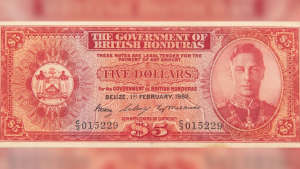
British Honduras aligned its currency one-to-one with the U.S. dollar, reflecting the colony’s firm economic standing and growing trade relationship with the United States. But that exchange rate with the dollar would not last. Because of the colonial government’s decision to peg Belize’s dollar to the British sterling, on December 31st, 1949, the British Honduras dollar value to US dollar decreased by thirty percent. This led to the Nationalist Movement and birth of the People’s Committee.
Joseph Waight
Joseph Waight, Financial Secretary
“The political movement in Belize was born out of – the nationalism was born out of 1949 of an exchange rate crisis at the time. It’s almost sacred and sacrosanct.”
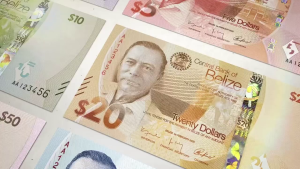 Another key event was the collapse of the Bretton Woods exchange rate between 1971 to 1973 when the United States broke away from tying the value of the US dollar to real gold, leading to a period of floating exchange rate in Belize. By the end of 1975 the British Honduras dollar had fallen to 50 cents of a US dollar.
Emory Ford, Chief Economist, Central Bank of Belize
“Although exports to sterling markets remained significant, the broader pattern of Belize’s trade and payments increasingly favoured a direct US dollar anchor. Belize made that choice on eleventh May 1976. The local currency was devalued by approximately twenty-nine percent, from seventy US cents to fifty US cents per Belize dollar, thereby establishing the parity od two Belize dollar to one US dollar. The decision replaced the sterling link with a direct US dollar anchor, returning the monetary system to the currency first used as its external reference in 1894.”
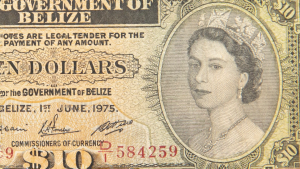 Since May 11, 1976, the Belize currency has been pegged to the US at two Belize dollars for one U.S. dollar. That fixed rate has remained unchanged for the past five decades, becoming one of the defining features of Belize’s monetary system and the Belizean identity.
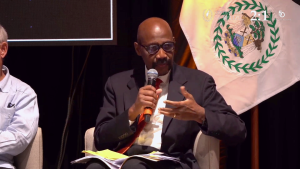
Stephen Duncan
Stephen Duncan, Banker
“I want to put it in this context. The P is for people. I agree with you Mr. Ford. Stability is all about making people’s life smoother, nicer, easier for us to live. We all want that. The E is for embattlement. That is our defense against the outside world, who are trying to force their style and ways on us and we have to use it to defend ourselves. We were able to stand up when Mexico went down in 1982 because of the peg. It is our embattlement. And the G, governance. It is the way we force our local leaders to maintain certain balance.”
The peg is also instrumental in Belize’s number one industry, tourism. For foreigners the result of the peg is a calculation that is easy to make.
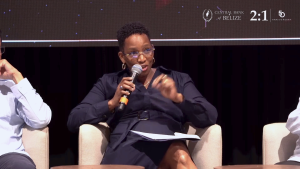
Carolyn Gentle-Genitty
Dr. Carolyn Gentle-Genitty, Panelist
“Belize is a beautiful country. By and large, many of us are happy. When you pair that with stable prices, you have a destination that people want to come. So tourism and a lot of our money relies then on the stability of the peg.”
Half a century after the May 11, 1976 decision to peg the Belize currency to the US dollar in a fixed exchange rate, it has proven to be a most prudent national policy. Shane Williams for News Five.
Attention readers: This online newscast is a direct transcript of our evening television broadcast. When speakers use Kriol, we have carefully rendered their words using a standard spelling system.
Watch the full newscast here: