


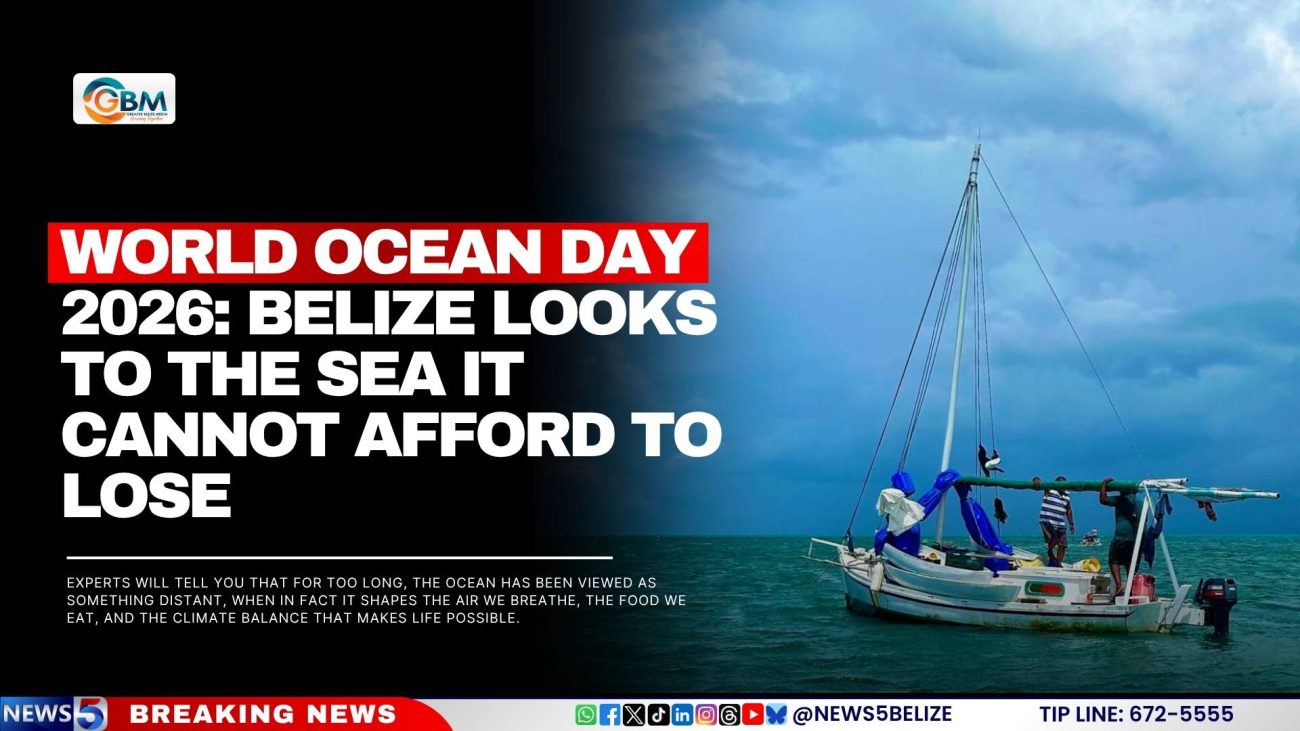
World Ocean Day 2026: Belize Looks to the Sea It Cannot Afford to Lose
This year’s theme for World Ocean Day, “Reimagine: Beyond the World We Know, a New Relationship with Our Ocean,” is a call to change the way humanity sees and cares for the sea.
Experts will tell you that for too long, the ocean has been viewed as something distant, when in fact it shapes the air we breathe, the food we eat, and the climate balance that makes life possible.
For Belize, that relationship is not abstract. It is economic, ecological and existential.
Jacinta Gomez, Campaign and Policy Director at Oceana Belize, says the 2026 theme resonates deeply with the work her organisation does every day. “I really like this theme because it invites everyone to rethink the way they look at the ocean,” she said. “I think for years we have seen it as a resource that we can extract from. There are exploitative industries, and so it invites us to look at the ocean as something that really sustains us.”
That shift in perspective from extraction to stewardship is at the heart of what World Ocean Day is asking of the world in 2026.
The Belize Barrier Reef is the largest barrier reef in the northern hemisphere, spanning a complex system of coral reefs, atolls, mangrove forests, coastal lagoons and estuaries that house rich marine life.
Belize’s tourism industry remains a critical pillar of the national economy, and the country’s world-famous barrier reef continues to drive visitor growth through diving, fishing, snorkelling and eco-tourism experiences. Belize’s tourism strategy in the mid-2020s has been closely intertwined with environmental policy and a broader shift toward a blue economy model, with international financial institutions describing the country as using marine conservation, sustainable fisheries and climate-resilient infrastructure as pillars for long-term growth.
But beneath the accolades, the reef is under serious pressure. The 2024 Mesoamerican Reef Report Card rated the overall health of Belize’s reef as poor, with a Reef Health Index average score of 2.5 out of 5 based on surveys at 110 sites. Climate change has been identified as the highest threat to the reef system, followed by run-off from land-based activities, fishing pressure, illegal uses and visitor impacts. Diseases like Stony Coral Tissue Loss Disease are also a growing threat, likely exacerbated by warming waters.
Fragments of Hope, the Placencia-based nonprofit that has become one of the most celebrated reef restoration projects in the Caribbean, marked the day with a message of both celebration and determination. “For us here at Fragments of Hope, every day is a reminder of how much we depend on the ocean and how much there is still worth protecting,” the organisation said. “Here’s to the reefs, the fishers, the divers, the scientists, the communities, and everyone doing their part to keep our ocean healthy for generations to come. Today we celebrate the ocean that connects us all and everyone working tirelessly to protect it.”
The Healthy Reefs for Healthy People Initiative echoed that call to collective action in its own message for the day: “By working together, we can restore what has been lost, protect what remains, and ensure that future generations inherit a thriving ocean and a stable climate.”