


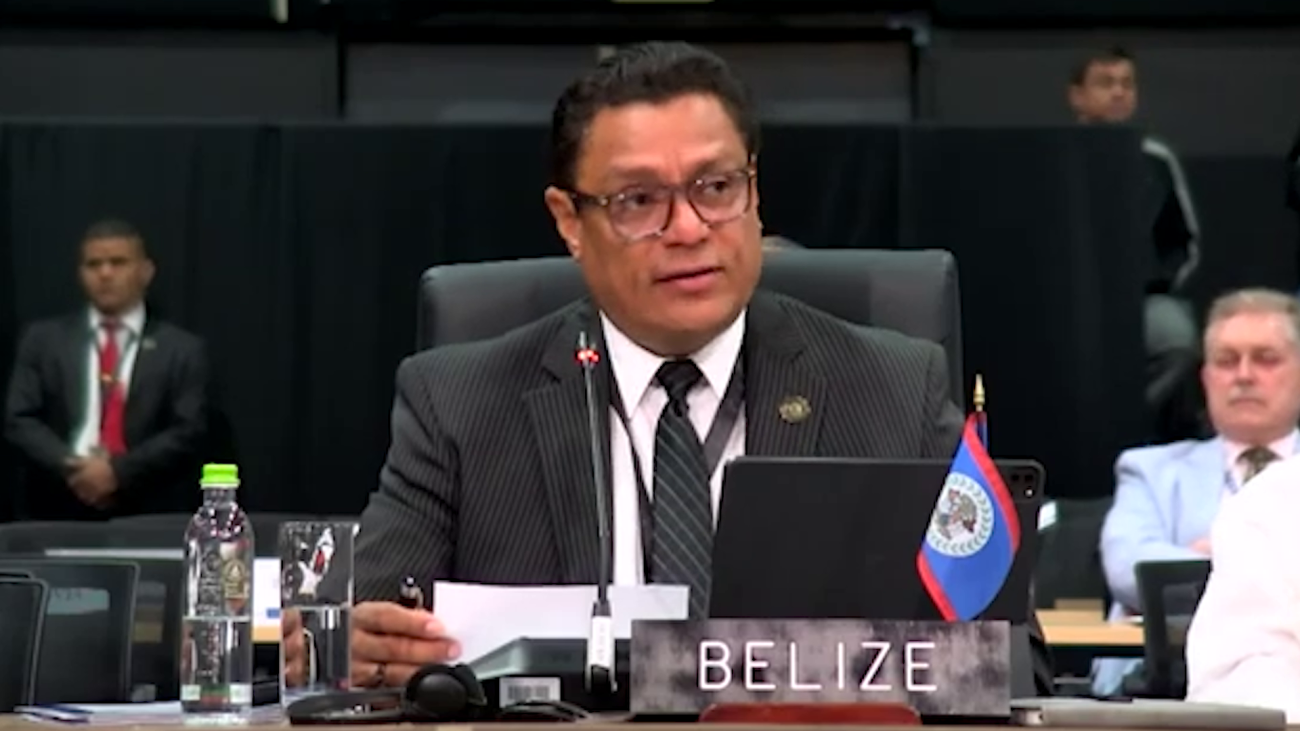
Belize Stands with Americas on Democracy and Stability
Belize is taking its voice to the regional stage, joining leaders from across the Americas to tackle some of the hemisphere’s biggest challenges. At this week’s OAS General Assembly in Panama City, the focus is on unity, how countries can work together to fight organized crime, defend democracy, and maintain stability. Representing Belize, CEO in the Ministry of Foreign Affairs Oscar Arnold is signaling the country’s commitment to strong partnerships and collective security in an increasingly complex region.
Oscar Arnold, CEO, Minister of Foreign Affairs
“For small states, a robust, transparent, and rules-based international and multilateral system is an essential element for security, stability, and at times, the very existence of our states. In a world where disparities in size, economic weight, and geopolitical influence remain a reality, multilateral institutions provide all states, especially smaller states, with something invaluable, a voice, a seat at the table, and a framework through which international relations are governed by agreed rules rather than raw power. They help ensure that sovereignty is respected, that disputes are settled peacefully, and that the interests of all states, regardless of size, can be advanced through cooperation rather than confrontation. In the Inter-American space, this role has been entrusted to the OAS for almost eighty years. While no multilateral institution is without its imperfections, the OAS has repeated-repeatedly demonstrated its value when member states allow it to function in accordance with the charter, its mandates, and shared principles. The organization is a trusted platform for political dialogue, collective action, and peaceful dispute resolution, while serving as the guardian of shared norms and commitments that bind our hemisphere together. As the regional cornerstone of multilateralism, the OAS must serve the needs of member states on the basis of charter and international law, notwithstanding the swinging pendulum of ideological euphoria. Today, member states require the OAS to navigate the complex geopolitical minefield in this hemisphere.”
In addition to passing security resolutions, member states also elected new representatives to key OAS institutions, including the Inter-American Juridical Committee and the Administrative Tribunal.

Belize Turns to OAS as Territorial Dispute Nears Final Judgment
With a high-stakes ruling on the horizon, Belize is turning to a trusted regional partner for support. At the OAS General Assembly, the country put its long-standing territorial dispute with Guatemala front and center, highlighting the organization’s role in guiding both nations toward a peaceful resolution at the International Court of Justice. Representing Belize, Foreign Affairs CEO Oscar Arnold underscored how the OAS continues to back that process, not just diplomatically, but on the ground, through its presence in the adjacency zone and support for strengthening national security efforts.
Oscar Arnold
Oscar Arnold, CEO, Minister of Foreign Affairs
“ Belize is grateful for the work and the role of the OAS as a credible partner, accompanying both Belize and Guatemala on the journey to a peaceful and definitive settlement of Guatemala’s claim to Belizean territory via the International Court of Justice, the quintessential example of rules-based multilateralism, which is expected to deliver its judgment in the coming year. Furthermore, the OAS offers a platform for institutional challenge to enable several permanent observers to support Belize and Guatemala with resources for the operation of the OAS office in the adjacency zone. Belize, like many of us here, grapple with the evolving threats of transnational criminal organization, including drug cartels in very close proximity of our borders. In response, we turn to the vaunted OAS to provide critical specialized training to our law enforcement agencies in areas ranging from combating money laundering to the tracking and marking of small firearms and munitions. The importance of strong multilateralism remains unquestioned, but recognition alone of this value is no longer sufficient. If we are to strengthen multilateralism for the future, we must focus on prevention, resilience, and opportunity. This requires a fresh examination of other critical pillars of the organization’s work, particularly the pillar of development. Democracy, security, and stability cannot be sustained without economic opportunity and sustainable growth. Citizens must feel tangible improvements in their lives if the democratic institutions are to maintain public confidence and legitimacy. For this reason, a renewed development agenda should prioritize initiatives that create enabling environments for micro, small, and medium-sized enterprises to generate dignified and decent employment, promote innovation, address the adverse impact of climate change, encourage fair competition, expand hemispheric trade. Such efforts must move beyond policy decisions toward practical, measurable interventions that deliver concrete results for our people.”
Arnold emphasized the need to integrate advanced technologies across the region through a multilateral approach, noting that evolving economies are increasingly dependent on them.
Attention readers: This online newscast is a direct transcript of our evening television broadcast. When speakers use Kriol, we have carefully rendered their words using a standard spelling system.