


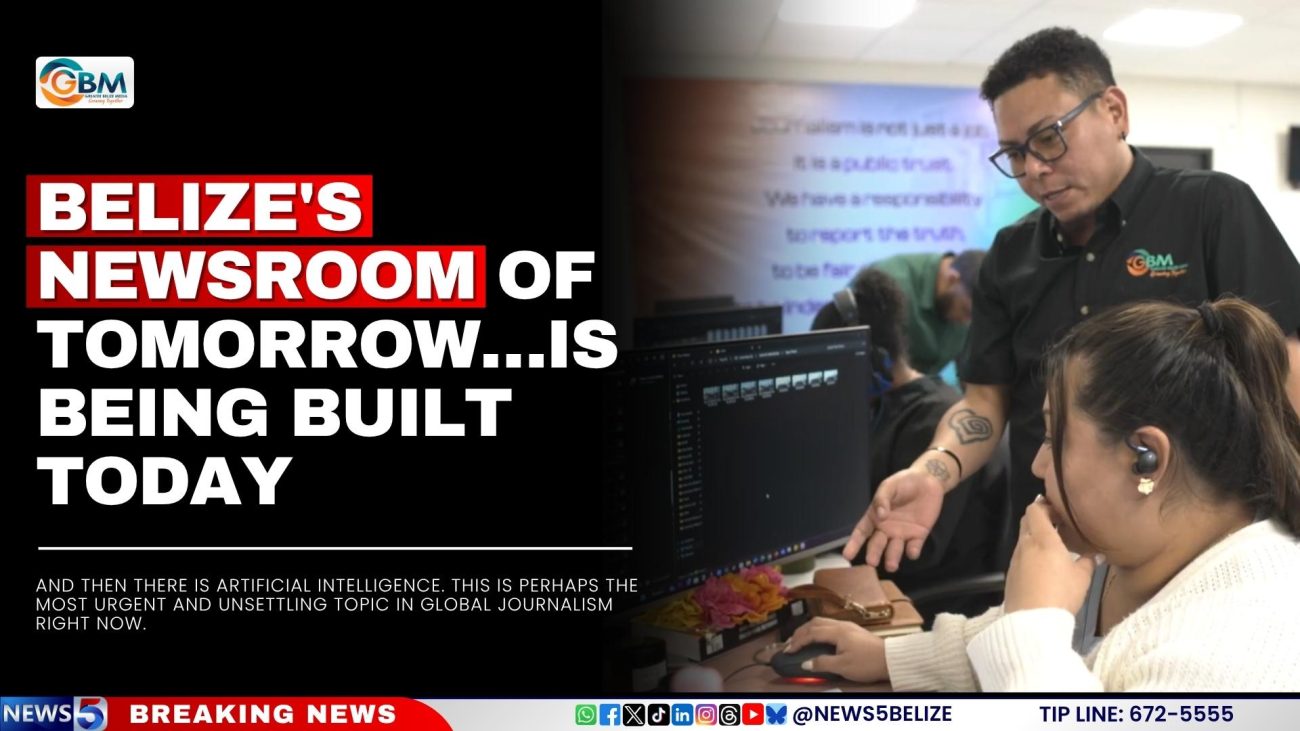
Belize’s Newsroom of Tomorrow…Is Being Built Today
The Caribbean media landscape is in crisis. That was the unmistakable message coming out of the Media Institute of the Caribbean’s Caribbean Media Summit 2026, held in Trinidad last week.
Legacy journalism is facing existential threats: declining revenue, the rise of artificial intelligence, and an algorithmically driven media economy that increasingly favours sensation over substance.
The conversation was necessary. The evidence, unfortunately, has been arriving in waves.
Consider what the past eighteen months alone have delivered to Caribbean journalism. Two major Caribbean newspapers shut down as readers increasingly turned to social media for news: Guyana’s Stabroek News and Trinidad and Tobago’s Newsday — both independent outlets that, according to the Media Institute of the Caribbean’s own president, Kiran Maharaj, represented a diversity of voice and perspective now narrowed. Newsday’s managing director attributed its collapse to a “perfect storm of challenges,” noting that print advertising revenue had fallen by 75% over the last decade. Stabroek News, for its part, cited a government debt of some $90 million owed for advertising services.

Belize’s Newsroom of Tomorrow…Is Being Built Today
Then came July 2025. In a move that sent shockwaves across the region, Digicel announced the immediate closure of Loop News. This was one of the Caribbean’s most trusted digital news platforms since 2014. Then there was the winding down of SportsMax, Digicel’s regional sports broadcaster. The decision affected nearly 100 jobs across the region, including journalists, editors, producers, and technical staff.
And in the US Virgin Islands, the losses have been even more historically staggering. The St. Croix Avis, founded in 1844 and by 1990 the oldest extant newspaper in the Caribbean, shut down in early 2024 after becoming unable to compete with online news and social media, ending 180 years of continuous publication in a matter of months.
At the summit, panelists who spoke on “Media Viability in the Age of AI” agreed that the current landscape is very challenging, if not outright gloomy. One speaker framed the viability question not as whether individual outlets can survive commercially, but whether societies can sustain trusted, independent, public interest journalism at all.
The pressures are structural: editorial, financial, technological, and political at once. These are not abstract concerns. They are the obituaries of institutions that journalists, communities, and democracies depended on.
But the picture is not uniformly bleak. Because while the region counts its losses, there is a newsroom in Belize that has been doing the hard, unglamorous, strategic work of preparing for exactly this moment, and has been doing it for some time now.
Greater Belize Media, home of News 5 Live, the country’s first news company to establish a dedicated and complete digital news department, did not wait for a summit to tell it that the algorithm was shifting, that AI was reshaping the information ecosystem, or that audience behaviour was evolving faster than traditional broadcast models could accommodate. GBM identified those realities early and started a dedicated digital department three years ago.

Belize’s Newsroom of Tomorrow…Is Being Built Today
And two years after, GBM made another big move: publicly unveiled its “One Newsroom” initiative, a structural transformation that brought reporters, videographers, editors and digital producers under one unified editorial roof. This is the same model trusted by major international newsrooms, adapted deliberately to serve the specific rhythms and needs of the Belizean public. The initiative was built on a simple but powerful insight: in a world where news is consumed in real time, across multiple platforms simultaneously, the old siloed model of broadcast and digital running on parallel tracks is not just inefficient, it is a competitive liability.
“The way news and news consumption is evolving is via social media and online platforms,” said Hipolito Novelo, GBM’s Digital Editor. “Consumers of news want to consume news almost immediately. That is what GBM offers, immediacy, and of course, the accuracy of it.”
That dual commitment (speed without sacrificing accuracy) sits at the core of what GBM has been building. It is easy to be fast. It is harder to be fast and right. And it is harder still to be fast, right, and present everywhere your audience is looking.
GBM has been present. The organisation has expanded its digital footprint across social media platforms, its website, WhatsApp channel, and Facebook Messenger channel. This was not an afterthought but rather deliberate nodes in an audience engagement strategy shaped by a clear-eyed reading of how Belizeans actually consume news today. GBM stays current with platform algorithm changes, adjusting its distribution strategy in real time rather than reacting to the consequences of falling behind.
And then there is artificial intelligence. This is perhaps the most urgent and unsettling topic in global journalism right now.
GBM has similarly refused to be reactive. While many newsrooms are still figuring out what AI means for their workflows and their editorial integrity, GBM is already working toward a formal AI policy, joining a growing number of newsrooms worldwide that recognise that responsible AI adoption requires governance, not just experimentation.

Belize’s Newsroom of Tomorrow…Is Being Built Today
“We are not afraid of AI,” said Novelo. “We are studying it, understanding it, and figuring out how to use it in ways that make our journalism stronger. Not shortcuts that compromise it. Every single day we are working to make sure we are ahead of it, not behind it.”
That posture, curious, strategic, disciplined, reflects a broader organisational culture at GBM that the Caribbean Media Summit’s conversations point to as exactly what the industry needs more of. The path forward for regional media lies not in lamenting the disruption, but in building institutional resilience: the capacity to adapt editorially, technologically, and organisationally to a media environment that will not stop changing.
“What we’re doing here is not reactive,” Novelo said. “We watch how the algorithms evolve, we watch how audiences shift, we adjust our strategy, and we keep delivering. That is the job. The landscape changes every single day and we change with it, because our audience deserves a newsroom that never stops working to reach them.”