


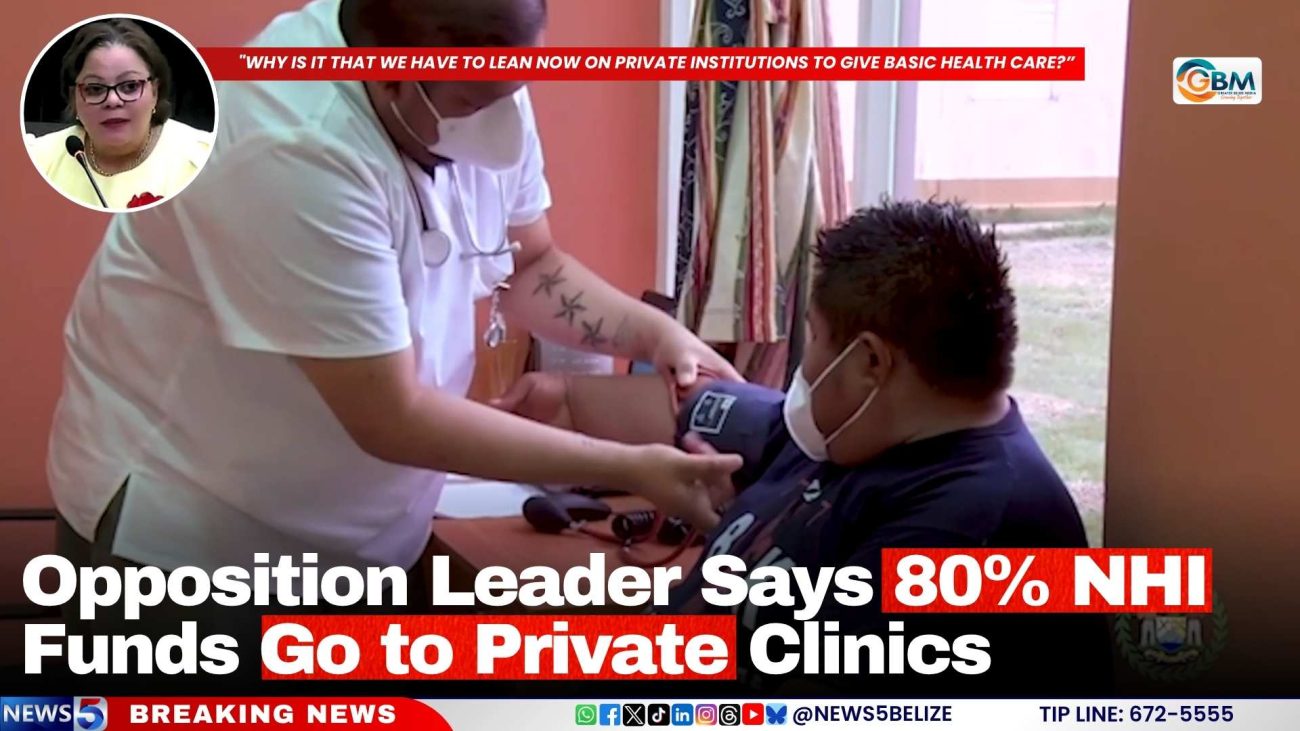
Opposition Leader Says 80% NHI Funds Go to Private Clinics
The second reading of the National Health Insurance Authority Bill 2026 was passed during Thursday’s House of Representatives debate. However, a pointed part of the debate focused on whether Belize’s National Health Insurance (NHI) programme is quietly shifting the country’s healthcare towards private providers, with the opposition accusing the government of neglecting the public healthcare system while funnelling the majority of NHI contacts to private clinics.
Prime Minister John Briceño pitched the bill as a “long-term nation-building initiative”, while the opposition warned the legislation centralises too much power and lacks sufficient accountability.
Opposition Leader Tracy Panton told the House that 80% of NHI services are currently being procured from private healthcare facilities, with only 20% going to public institutions.
“Why is it that we have to lean now on private institutions to give basic health care? It makes no sense… There’s no need.” Panton said. “Can we perhaps use a portion of those resources now being allocated to procurement of services to invest in public healthcare facilities so that they can provide universally primary healthcare for all Belizeans?”
Panton argued the bill risks creating what she called a parallel funding system that socialises public risk while protecting private benefit. She said it could become “another LIU” if left without sufficient oversight.
While Minister of Health and Wellness Kevin Bernard did not directly address Panton’s claims, he did push back by pointing at seven new public sector NHI providers, including polyclinics in Orange Walk, Belmopan, and San Ignacio.
Meanwhile, Briceño defended the model on efficiency grounds for the NHI. He argued that contracting both private and public providers allows NHI to drive down costs through bulk purchasing.
“If you go to a private clinic, you pay $50. We pay about $12. Why? Because the doctor is assured that they are going to have over 4,000 patients coming in,” Briceño said. He explained that this same principle applies to the procurement of medicines. By consolidating thousands of patients under a single system, the NHI is able to negotiate much lower rates with providers.