


Dozens of Baby Sea Turtles Found Dead on Belize Beach
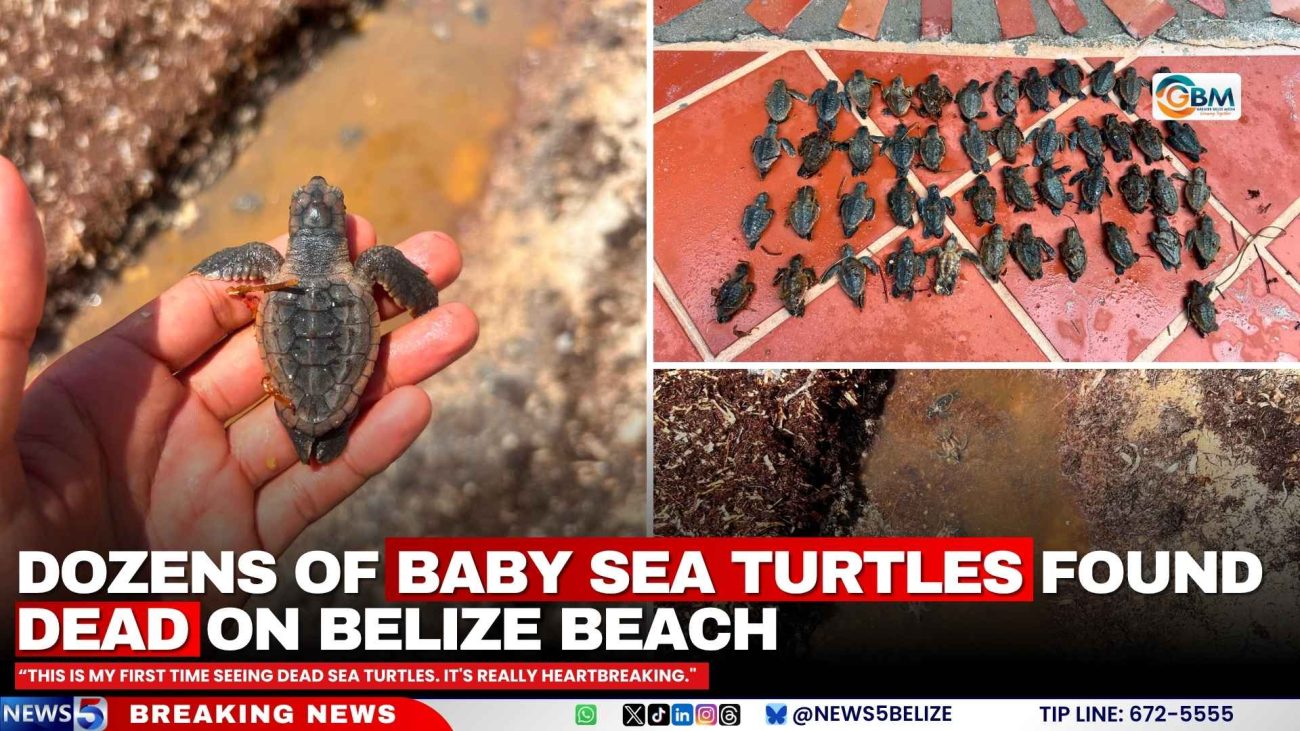
At least 52 loggerhead sea turtle hatchlings were found dead on a private beach on Ambergris Caye earlier this month.
Residents say this is the latest casualty of the country’s worsening sargassum crisis.
Joshua Seguro, a part-time worker on the property, discovered the hatchlings early in the morning while walking the beach. “I immediately identified them as loggerheads, Caretta caretta, and in my head I was like, ‘Oh no, these are dead,'” Seguro said. He alerted the property owners before contacting the Belize Fisheries Department.
Fisheries officer Alicia Eck, working alongside the Belize Sea Turtle Network, was notified and guided the group through next steps by phone. She advised them not to touch the hatchlings and to count how many they could find to determine the scale of the die-off.
“They gave us the laws that you cannot touch wildlife,” Seguro said. “And they told us to count how many we could see so we could get a wider scope of what really happened.”
By the end of the count, the group had recorded 52 dead hatchlings, which appears to be an entire nest that never made it to the water.
“I’m fully convinced it’s the sargassum.”
Dozens of Baby Sea Turtles Found Dead on Belize Beach
Seguro said the culprit is unmistakable: thick mats of decomposing sargassum seaweed choking the shoreline.
“The water is absolutely disgusting,” he said. “Even us, who live on land, and the house is maybe 50, 60 feet away from the beach, we can smell the decomposing aroma. So imagine these delicate hatchlings, one or two hours old, trying to navigate into the deeper water.”
Property owner Maria Sussman, who purchased the home with her husband Scott, said the family initially thought the turtles were alive. “Josh came up in the morning and showed the picture of turtles and said, ‘Do you want to see the sea turtles?'” she recalled. “We have a five-year-old daughter, and we all rushed to the beach… First we saw 17 turtles closer to the beach, and as we walked further along the pier, we started seeing more and more stuck in the sargassum.”
The family searched for the original nest, hoping to find and save any hatchlings still inside, but were unable to locate it, likely buried beneath their pier.
A pattern, not a one-off
Seguro, who has spent summers on the property for over 15 years, said the discovery marks a stark decline from what he remembers as a child.
“Growing up, we would come out at night and see them go into the ocean,” she said. “The last time I saw a hatchling in the area was maybe 10 years ago, and that one was stuck in sargassum, which we removed and released into deeper water. But we’ve never seen anything like this. Especially dead. This is my first time seeing dead sea turtles. It’s really heartbreaking.”
Seguro said he has since learned of a similar discovery roughly 300 feet down the same stretch of coastline. “Now imagine the entire coastline of Belize,” he said. “How many turtles are dying every single day?”
Calls for government action
Dozens of Baby Sea Turtles Found Dead on Belize Beach
Scott Sussman, husband to Maria, called the deaths “a tragedy” and pointed to the scale of what may be happening undetected across Belize’s coast.
“This could be hundreds of thousands of turtles dying a month during hatching season,” he said. “What I think could be done is for the Belizean government to step in and really make a real effort to control this sargassum problem. Mexico did it. I believe the Belizean government, if they would use the funds appropriately, especially the $25 million they just received, to attack this problem, the sea life would benefit greatly.”
Scott said the sargassum on his stretch of beach is now so thick that it can’t be walked without hired labour to clear it, a problem he described as daily and worsening.
“Without government intervention, this is going to be horrific for the sea life,” he said.
Scott’s mother-in-law Roberta Schulte added that the die-off raises questions about what else may be affected. “You’re talking about the preservation of a species, and you don’t know what other species are being impacted,” she said. “People come to Belize for the sea, and to see what is being allowed to happen is really disappointing and possibly a deterrent for tourism.”
Scott described a recent boat trip roughly five miles north, where he said the water reeked of decomposition, with hundreds of frigate birds and other seabirds feeding on dead fish in a discoloured channel. “Josh’s uncle told me stories about porpoises that used to swim right in front of our beach and lobsters everywhere,” Scott said. “Now all there is is murky brown water and sargassum for 150 feet from the beach out.”