


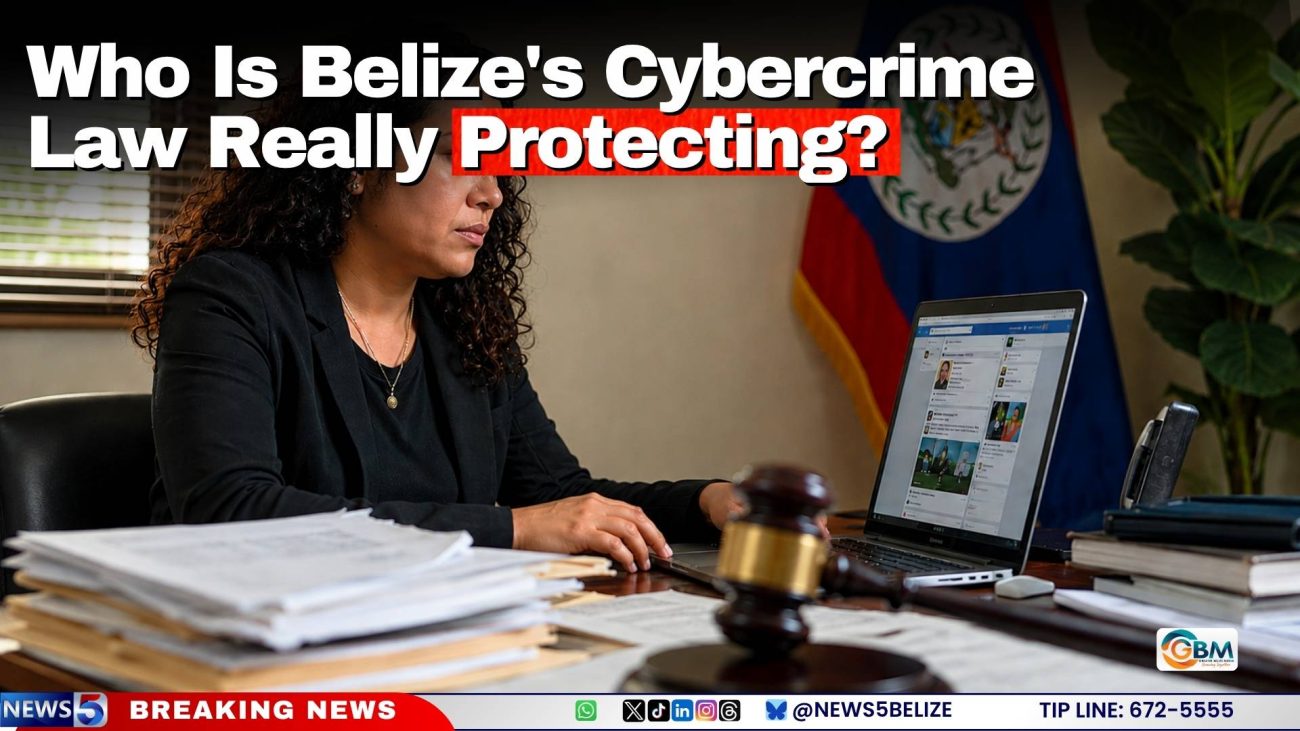
Who Is Belize’s Cybercrime Law Really Protecting?
When Belizeans lobbied for the cybercrime legislation, they had something specific in mind: children being lured online, women threatened with revenge porn, and teenagers driven to despair by school cyberbullies.
A scenario involving a PUP cabinet minister and six armed police officers arresting a very vocal former UDP chairman over what is arguably a satirical social media post was likely not in anyone’s mind.
But that’s what happened on Saturday, May 30th, when Alberto August sat in a police cell for 28 hours after Home Affairs Minister Oscar Mira filed a cybercrime complaint against him. The charge: using a computer system to disseminate a false statement.
The case has cracked open a question that has gained massive public attention: has the Cybercrime Act become a tool for the powerful to silence critics?
What the Law Was Actually Built For
The Cybercrime Act, No. 32 of 2020, was passed in October of that year and gazetted on the 7th. Its stated purpose is to combat cybercrime by creating offences, providing for penalties, and governing the investigation and prosecution of those offences.
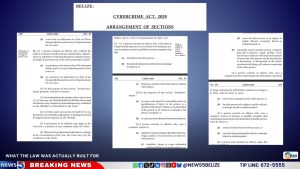
What the Cybercrime Law Was Actually Built For
The intent of the legislation is not ambiguous. Section 11 targets child luring, making it an offence for anyone to use a computer system to communicate with a child with intent to induce sexual conversation, encourage child pornography, or arrange a meeting for abuse. Section 12 covers the non-consensual sharing of intimate images, which is commonly known as revenge porn.
Section 15 creates offences for using a computer system to coerce, harass, intimidate or humiliate another person. Subsection 4, the one at the centre of the August case, reads: “A person commits an offence who uses a computer system to disseminate any information, statement or image, knowing the information, statement or image to be false, with the intent to cause harm to the reputation of the other person.”
On paper, that provision makes sense in the context of targeted harassment, fabricated screenshots used to destroy someone’s livelihood, or coordinated disinformation campaigns against a person. Whether it was ever intended to apply to political satire, mocking a minister on Facebook, is a different question entirely.
Attorney Leslie (Darynka) Mendez made that argument plainly in an online post after August’s arrest, labelling it as “insane.” “This completely twists what cybercrime laws were actually made for,” Mendez said. “Public officials have no business using these laws to go after their critics. When people were advocating for cybercrime legislation, they did so to protect private citizens, children, and young people dealing with cyberbullies at school, children being lured by adults, and women facing threats of revenge porn, not these big age people, who willingly chose to roll in the political mud, fully knowing that criticism, whether fair or unfair, is the name of the game.”
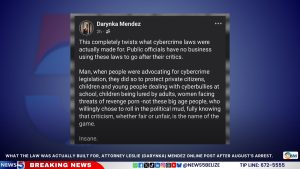
What the Law Was Actually Built For, Attorney Leslie (Darynka) Mendez online post after august’s arrest.
The August Arrest: What Actually Happened
The Friday before his arrest, August published a Facebook post mocking Mira over the murder of Dr Naun Bonilla, a Belmopan medical officer killed in what has become a flashpoint for public frustration over crime. August’s post mimicked a statement the minister made months earlier following a separate murder in Belmopan of two cousins.
August said in this online post, “In Ocsar Mira’s deepest voice; ‘The murdered young medical doctor is from Valley of Peace. He does not live in Belmopan. He only comes to work in Belmopan and to bring his 5 year old child to school in Belmopan. We cannot therefore say that Belmopan is not a safe place to live because this doctor DOES NOT live in Belmopan.’”
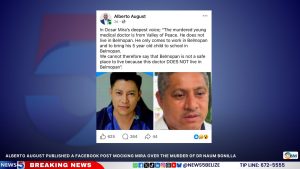
Alberto August published a Facebook post mocking Mira over the murder of Dr Naum Bonilla
Mira says the post put fabricated words in his mouth. August maintains it was political satire.
Mira responded the same day, saying, “I have seen the social media post made by Mr. Alberto August… It is a shameful attempt to exploit the tragic murder of Dr. Naun Bonilla through the deliberate distortion of facts and the attribution of statements that I never made. Let me state unequivocally: I never said what Mr. August claims I said. Those words are entirely his invention.”
Just before signing off his online statement as the Minister of Home Affairs and Enterprise, Mira went further and said, “And you can be sure that any and all legal recourse available to me will be pursued to ensure that disgusting Alberto August pays for this attack on my name.”
By Saturday morning, August says six armed police officers were at his home with a search warrant. They seized his phones and computers and took him to a police station.
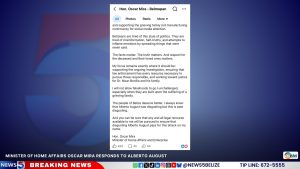
Minister of home affairs Oscar Mira responds to Alberto August
His attorney and former UDP senator Michael Peyrefitte said August was held for 28 hours before being released on Sunday afternoon, after the Prime Minister reportedly intervened to allow station bail. “It was executed with military precision,” Peyrefitte said. “Unless it is what it exactly was: a hit sent out by the Ministry of Home Affairs to lock up Alberto for the weekend because he hurt the minister’s feelings. You don’t put a person in a pisshouse for a post. If you post some false narrative, in your view, and you feel offended, you send a letter before action. You sue in a civil court if that’s how you feel.”
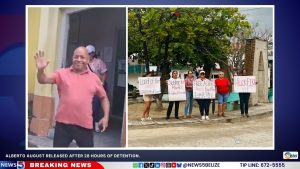
Alberto August released after 28 hours of detention.
“Mentally sir, it is not an easy situation,” August said on Monday. “Being in detention for that kind of period of time, it certainly has an effect on you. But if the intention of the minister was to humiliate me and to cause anxiety and stress for my family, he succeeded.” August maintains he does not regret the post.
The Precedent Problem
The August case is not the first time a person in authority has turned to the Cybercrime Act against a critic. Former Commissioner of Police, now CEO of the Ministry of Transport, Chester Williams used the same laws to bring two separate court cases against individuals he claimed had cyberbullied him.
The former ComPol filed cyberbullying charges against Nichole McDonald, which were later dismissed in 2025 just before being reinstated earlier this year in May. While Williams has denied any involvement in the reinstatement of the charges before the court, the revival raised some questions. At the same time, a separate cyberbullying case brought by Williams against Police Officer Barry Flowers collapsed in court just days later after Williams failed to appear for trial. In dismissing the matter, Senior Magistrate Neeshad Mohammed criticised his absence and described it as a disrespect to the court and warned that the judicial system should not be used to pursue personal vendettas.

ormer Commissioner of Police, now CEO of the Ministry of Transport, Chester Williams used the same laws to bring two separate court cases.
These recent cases have intensified debate over the growing use of cyberbullying legislation in disputes involving public figures.
However, Belize is not alone. Around the world, the use of cybercrime laws against the very people they were meant to protect has been widely viewed as a troubling misuse of those laws.
In March 2017, Latoya Nugent, co-founder of the Tambourine Army, a women’s rights movement that publicly named alleged perpetrators of sexual violence on social media, was arrested and charged with three counts of “using a computer for malicious communication” under Jamaica’s Cybercrimes Act. The charges were eventually dropped two months later.
Meanwhile, in Nigeria, at least 25 journalists faced prosecution under that country’s Cybercrimes Act before reforms were introduced in 2024, according to the Committee to Protect Journalists. At least two journalists from an independent news agency were questioned for over nine hours by Nigeria’s National Cybercrime Centre over stories alleging corruption. The charge: “cyberstalking and defamation of character.” The Committee to Protect Journalists called the law “a readily available tool to harass the press.”
In Tunisia, authorities used cybercrime laws to detain journalists, lawyers, and students for their public statements online. In Jordan, a 2023 cybercrime expansion led to prosecutions for offences as vague as “spreading fake news” and “character assassination.”
Belize’s Section 15(4) of the Cybercrime Act, the provision under which August was charged, mirrors the same structural weakness found in every one of these laws.
At the same time, the Act gives investigators significant powers. Under Section 21, a Search and Seizure Warrant can authorise police to enter a home, seize computers and phones, make copies of data, and render systems inaccessible. Under Section 15(6), a conviction can bring a fine of up to $10,000 and five years in prison on summary conviction, or $15,000 and ten years on indictment.
These are serious powers that sit inside a law that has no explicit carve-out protecting political speech, satire, or fair criticism of public officials.
Peyrefitte put it directly: “What the PUP did over the weekend is scary because they are saying that if I don’t like your criticism of me, I will lock you up. What type of society do we live in? When you can’t even go on social media and criticise someone in government?”
“You’re a political figure, you are subject to criticism, you are subject to be made fun of, subject to ridicule,” Peyrefitte added. “We have gotten to the point where we seriously cannot even criticise these people. You cannot even have an opinion if that opinion is going to hurt the feelings of some tender minister who cannot handle being criticised or being mocked or being ridiculed, which is a part of being in government.”
The Government’s Response
Meanwhile, Prime Minister John Briceño backed his minister. He said on Wednesday that Mira was exercising his rights as a private citizen. “Oscar Mira also is a citizen, and if he feels that somebody is slandering him, he has every right to go and make a report,” Briceño said. “He made a report, which is his constitutional right.”
However, when pressed on whether he would do the same, the PM was dismissive, saying, “Alberto August wouldn’t take up the time of my efforts in dealing with him. He can say whatever the hell he wants, and it doesn’t bother me a bit. ” But in the same breath he added, “But we’re all different, and sometimes we do need to take a stance. Maybe I should consider taking out lawsuits against Alberto August; maybe I should have all PUPs take out lawsuits against him.”
Briceño rejected the characterisation of August’s post as satire, questioning, “You think what Alberto August does is satire? Let’s get that straight. What Alberto August did is disgusting.”
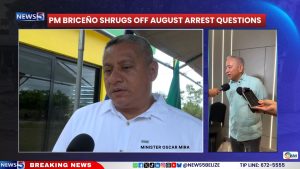
Prime Minister John Briceño backed his minister of Home Affairs, Oscar Mira
Mira, for his part, has insisted he acted as a private citizen and denied any abuse of office. He argued public officials do not surrender their constitutional rights simply by holding power. He also maintained there is a line between criticism and slander and that August’s post crossed it by presenting fabricated quotes.
Those are arguments a court will have to weigh. But they sit uncomfortably alongside another fact: Mira’s brother, Brian Mira, posted online after that he would “take a charge” if he saw August. “I really would,” Brian added. He has sinced deleted the post. Peyrefitte said, “he’s not arrested for that. He’s not being detained for that. You don’t have six policemen at his house trying to arrest him and put him in jail for the weekend. So there is the imbalance.”
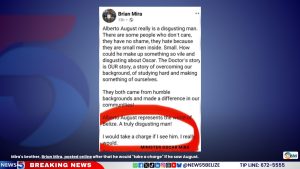
Mira’s brother, Brian Mira, posted online after that he would “take a charge” if he saw August.
The Real Question
Belize’s Cybercrime Act contains a broad provision in Section 15(4) that criminalises the dissemination of information “knowing” it to be false, with intent to damage reputation.
Depending on how a court interprets “knowing” and “false,” that single subsection could be applied to any number of posts, memes, exaggerated claims, or satirical accounts that circulate on Belizean social media daily.
The question is not whether ministers have rights. The question is whether those rights should include the power to mobilise the police, seize a critic’s devices, and hold them in a cell for 28 hours over what August continues to describe as a satirical Facebook post.
Attorney Mendez called it “insane.” Peyrefitte called it politically motivated and legally baseless, and the public, watching the story unfold, was not far behind.
Across the same social platform where August’s post triggered the chain of events, Belizeans raised the same alarm in different words: that the ability to criticise, mock, and challenge those in power is not a courtesy extended by the government; “it is a right,” one user said.
The user added, “It is our constitutional right to criticise elected officials, and when the people can’t mock or criticise the government without retribution, then we are in tyranny, an authoritarian regime… a very slippery slope!”
“The line between a democracy and something else starts to blur,” another user added.
Some called for the laws to be amended, while others expressed their “fear of losing freedom of speech.”
“Because of social media now, things are coming out, and politicians are scared because the corruption is coming to light. We have the right to voice and protest if governments are doing wrong; this is not a dictatorship country, or is it?”